
Online visibility and business expansion have become dependent on search engines in the modern world of intense competition that is propelled by the digital era. Although such high-quality tools as Ahrefs, SEMrush, and Moz provide useful functions, they have a steep cost that may cause limitations in the finances of a startup, freelancer, and small company. This is where Open Source Tools come in as the game changers. Free and community-based, these solutions offer powerful functionality without subscription charges, leaving the management of your data and processes fully in your hands.
You are a developer and want to be presented with flexibility; you are a startup and have a small budget; you are an SEO specialist and need to maintain a number of clients happy; you are a businessman, and all these options will serve you with an open-source option and keep your wallet jingling. This complete list defines the 10 best Open Source SEO tools that will help you revolutionize your SEO plan in 2026.
What Are Open-Source SEO Tools?
Open-source SEO tools Open-source SEO tools are software that can be inspected, modified, and improved by anyone because the source code is publicly available. In contrast to proprietary software, it is open and encourages community participation where developers all around the globe can make them better, correct bugs and add features. The open-source principle insinuates that you are not bound to the chains of the vendors or even pricing schemes; you are at liberty to devise the tool to suit your particular requirements fully.
These Open Source SEO Tools are self-hosting meaning that you can host them on your own servers and enjoy the freedom to own the entire data ownership and privacy. They are especially useful when the searching companies possess technical skills and wish to implement the SEO feature in their current systems or develop dedicated processes that cannot be incorporated in paid tools.
How They Differ from Paid or Freemium SEO Tools
- Cost Structure: Open-source tools are completely free to use with no subscription fees, while paid tools require monthly or annual payments that can range from $99 to $500+ per month.
- Data Ownership:In the case of self hosted open source solutions, all of your data (SEO data) is on your servers, whereas your data is in the clouds in paid solutions.
- Customization Freedom: Open-source software gives you complete freedom to code and add features to your code, whereas paid software can only enable you to increase features and make updates as dictated by the software developer.
- Support Model: Paid tools provide professional customer support teams, whereas the open-source tools refer to forums, documentation and self-help in troubleshooting.
- Update Control: You decide when to update open-source tools and can even maintain older versions, whereas paid tools force automatic updates that may disrupt your workflow.
- Scalability Costs: Open-source tools can be made to scale without extra costs in terms of licensing (only costs on servers) whereas paid tools incur higher costs of additional users, projects or data limits.
Why Open Source Seo Tools Are Ideal for Developers, Startups, and SEO Professionals
- Low-Cost Performance: Startups will be able to use their resources to invest in marketing and product development rather than paying costly subscriptions with SEO, and can save the resulting money to invest in the business growth.
- Technical Flexibility: Developers have the ability to build in open-source tools and come up with harmonious workflows alongside tailored dashboards that align with their tech stack.
- The study of open-source code assists the SEO haters of each query in comprehending the workings of the algorithms and ranking factors at a more technical level.
- The search engine optimization structure does not rely on business choices, pricing fluctuation, or possible service termination within a firm.
- By storing sensitive qualifications in-house, self-hosted solutions simplify the process of complying with GDPR, CCPA and other data protection laws.
- The contributions made by global developers to open-source projects are an advantage as it may have faster bug fixes and innovative features that the paid tools may take months to introduce.
10 Best Open Source SEO Tools (Free & Self-Hosted Options)
1. Matomo (formerly Piwik)
Matomo is a web analytics software that can be used as an effective alternative to Google Analytics, a potent open-source tool. It has in-depth information about traffic to the website, user behavior and conversion monitoring besides giving you the ownership of 100 percent data.
Boasting of its powerful SEO capabilities, such as tracking search engine keywords, campaign attribution and visitor flow, Matomo will make you know precisely how people get to know about your site and its activities. The site can hold infinite websites, users and storage, hence can be scaled to any company. It is privacy-oriented to comply with GDPR without compromising the quality of analytics.
Key Features:
- Complete data ownership
- Live data analysis company.
- SEO keyword tracking
- Individual reporting features.
Best For: Businesses that are privacy conscious and want a privacy-driven alternative to Google analytics along with complete data control.
Link: https://matomo.org
2. Screaming Frog SEO Spider (Free Version)
The widely used and popular website crawler among the techno SEO specialists is Screaming Frog SEO Spider. Whereas the paid version will allow an infinite number of pages to be crawled, the free will crawl 500 URLs per site which is adequate to small to medium sized sites. It is a simulator of the way search engine bots browse your site, which points to the technical problems of broken links, redirect chains, duplicate content, and absent meta tags.
The tool is the best at the generation of XML sitemaps, page titles and descriptions analysis, and extraction of structured data. Its graphical interface renders complicated technical audits easy to use, even with non-technical users, and allows advanced users to use custom extraction and API connections.
Key Features:
- Website crawling analysis
- Broken link detection
- Meta data extraction
- XML sitemap generation
Best For: Technical audit of SEO and monitoring the health of the websites of small to medium size.
Link: https://www.screamingfrog.co.uk/seo-spider/
3. Serposcope
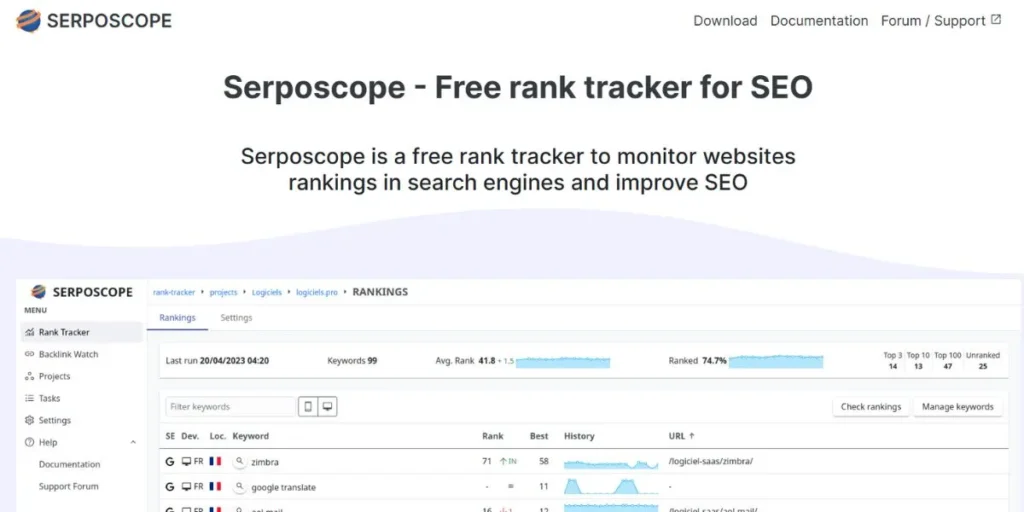
Serposcope is a free, open source rank tracking application, which can be used to monitor the rank of your site in various keywords and locations of every search engine. In contrast to other rank trackers based in the cloud, which operate on a pay-per-keywords model, Serposcope allows tracking of an unlimited number of websites and an unlimited number of keywords at no cost.
The tool eases tracking of the Google search engine with adjustable locations and other devices (desktop/mobile) thus ideal in local search engine optimization campaigns and for businesses having multiple locations. It is a Java-only type of application that is supported on Windows, Mac and Linux with few requirements to set up.
Key Features:
- Unlimited keyword tracking
- Tracking of ranks across locations.
- Historical ranking data
- Self-hosted privacy control
Best For: Agencies and SEO professionals tracking multiple client websites and keyword portfolios
Link: https://serposcope.serphacker.com
4. Yoast SEO (WordPress Plugin)
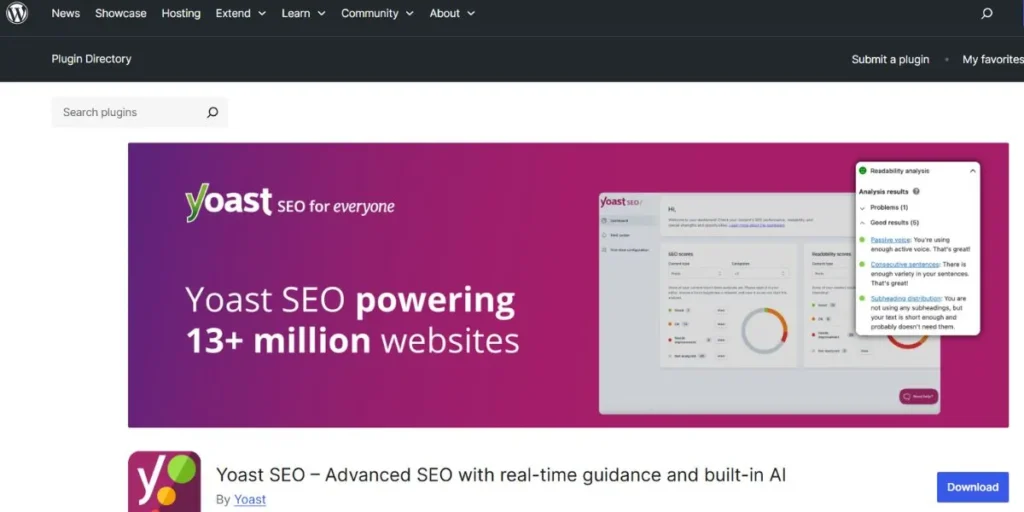
Yoast SEO is the most popular open source seo tools in the world with more than 5 million websites running on its easy-to-use optimization functionality. Although it is mostly recognized as a freemium tool, its core aspects are pure open-source and free. The plug-in assists the content creators in on-page optimization by displaying real-time readability, key-board analysis and meta description in the webpage.
It also automatically generates XML sitemaps, canonical URLs and schema markups without the need to know any code. SEO is also available to beginner-level users with the use of the traffic light system (red, orange, green) without having to possess advanced controls to allow more experienced users to optimize title templates and social metadata to their liking.
Key Features:
- On-page optimization of content.
- XML sitemap automation
- Marking out readability analysis.
- Implementation of schema markup.
Best For: Supporting WordPress website owners who would like on-page SEO optimization and content advice based on their level and expertise.
Link: https://wordpress.org/plugins/wordpress-seo/
5. OpenLinkProfiler
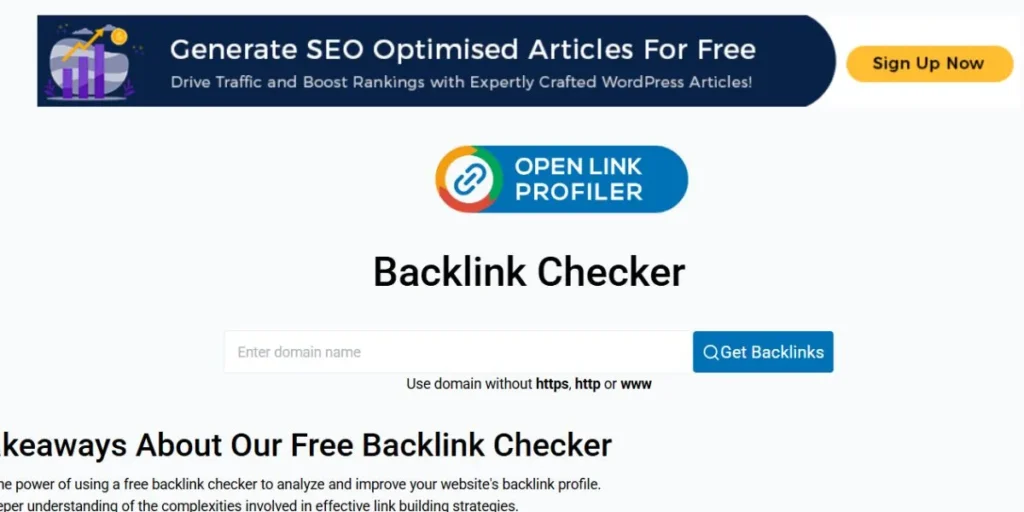
Compared to such tools as Ahrefs or Majestic, OpenLinkProfiler offers full-fledged backlink analysis at the expense of its premium costs. It lists and crawls billions of links, and provides deep insights into your backlink profile such as link influence scores, the distribution of anchor text, and linking domain authority metrics. The tool determines the best backlinks that you have and possible toxic linkages that may have a negative impact on your rankings.
It has a fresh index that changes every now and then so that you are not looking at old information that might be old. You can research backlink strategies employed by the competitors, find link building opportunities and export data to be used in further analysis doing it through an intuitive interface which is both user-friendly and easy to use by the beginners and the seasoned SEO professionals.
You can research backlink strategies employed by competitors and discover new link-building opportunities. Tools and platforms like Rankwithlinks can further help streamline outreach and improve backlink acquisition efforts without relying entirely on expensive premium solutions.
Key Features:
- Backlink profile analysis
- Link influence scoring
- Competitor link research
- Toxic link identification
Best For: Small businesses and freelancers needing affordable backlink analysis and link building research
Link: http://openlinkprofiler.org
6. SEO Panel
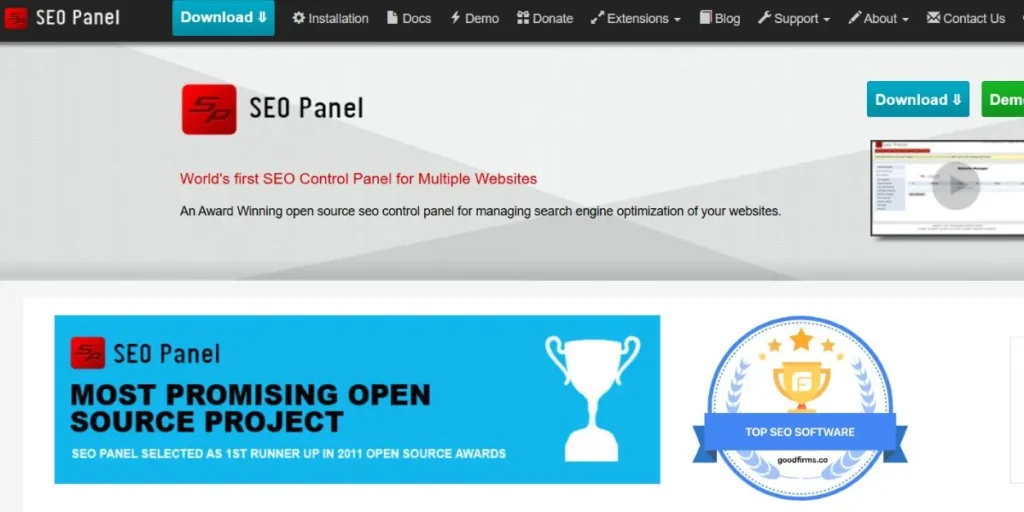
SEO Panel is a fully independent, self hosting, SEO control panel that focuses a series of SEO services in a single dashboard. It is an open source platform that provides automatic directory submission, checking of key words position, sitemap generator and back links monitor meaning that one is making his own private search engine command centre.
Its modular design lets you select the features you require in order to maintain a clean and focused interface. Developers are free to expand the functionality to fit unusual workflow needs with the assistance of its plugin system, and the vibrant community supplies themes, translations, and frequent updates of features.
Key Features:
- Multi-websites control panel.
- Automated rank checking
- Automation of the submission to the directory.
- Backlink monitoring system
Best For: International SEO agencies requiring a centralized, self-hosted platform for managing multiple client websites
Link: https://www.seopanel.org
7. Google Search Console (Free Google Tool)
Although it is not true that it is open-source, Google Search Console has to be brought up as the direct free webmaster and SEO tool offered by Google. It is one of the few sources that will present the first-hand observations that Google makes of your site and how search engines rank your site.
The platform also shows which queries are bringing traffic to your site, which crawl and mobile usability errors occurred, and permits hand indexing of new pages. Security alerts inform you of hacking incidents or manual penalties and therefore is a vital monitoring tool irrespective of the other software you are using in your desktop to do SEO.
Key Features:
- Search query performance
- Index coverage monitoring
- Mobile usability testing
- Ingenious notification of action by a man.
Best For:Each and every website owner who requires searching authority of Google applications and thumbprint of indexing.
Link: https://search.google.com/search-console
8. Apache Nutch
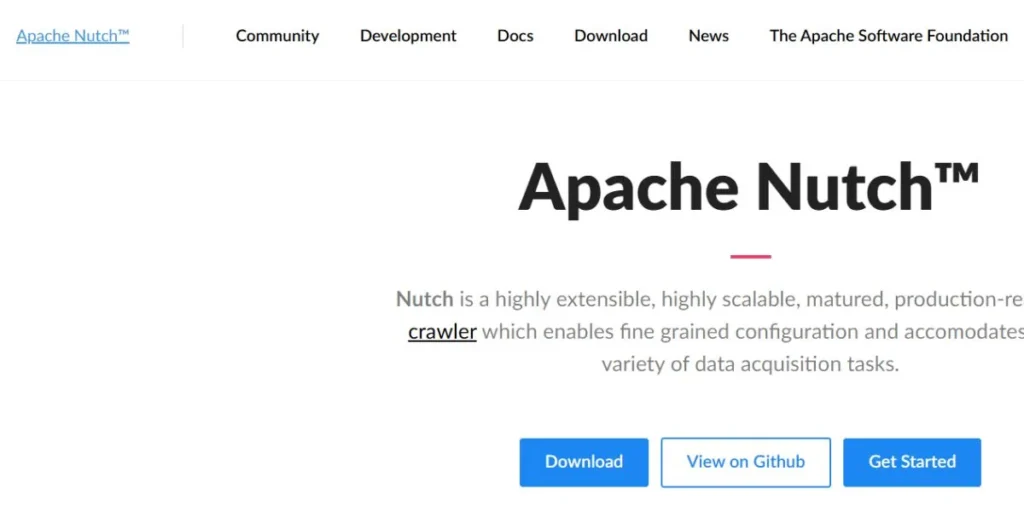
Nutch, an enterprise-level, high-extensible web crawler, is a web crawler that has been developed to collect and analyze data on SEO data, in large scale. It was developed by Apache Software Foundation and is able to crawl billions of web pages and can be configured to work together with Apache Hadoop to process huge amounts of data at any location.
Although it needs technical know-how to set up and scale, Nutch provides unmatched scalability/flexibility to custom SEO research work, scale-based competitive research, and proprietary SEO database development. Its Plug-in system enables individuals who have a programming background to customize their parsing, scoring and filtering, and hence it is the ultimate tool of SEO professionals.
Key Features:
- Large-scale web crawling
- Hadoop integration support
- Plugins can be customized highly.
- Processing capability that is distributed.
Best For: Enterprise SEO Teams and developers who may want to create their own large scale crawling and data analysis platform.
Link: https://nutch.apache.org
9. SearX
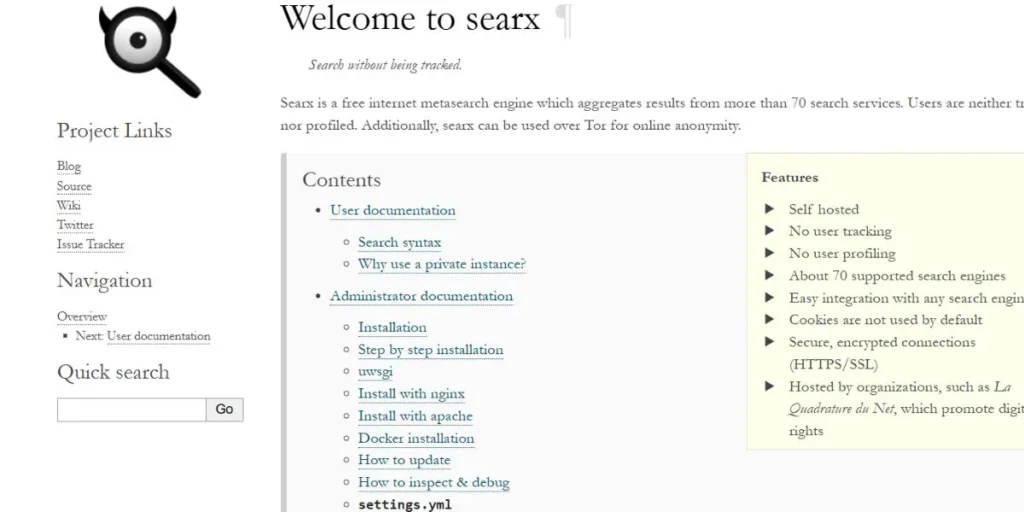
SearX is an open-source search engine- aggregator that obtains the results of more than 70 search engines that respects the privacy of users. To an SEO professional, this is priceless in terms of analyzing the relative ranking of the same search query in various search engines as well as the global search trends.
The searX allows one to carry out unlimited competitive research by hosting it themselves without having to disclose their queries to search engines or place digital footprints behind them. Its API can be used to integrate with custom search engine optimization processes, with automated rank checking and a SERP feature monitoring across a wide variety of search ecosystems.
Key Features:
- Multi-engine search aggregation
- Privacy-focused querying
- Self deployment alternative.
- Comparison of cross-engine SERP.
Best For: Privacy-aware SEO research where cross-platform search analysis and competitive intelligence are performed.
Link: https://searx.github.io/searx/
10. KNIME Analytics Platform

KNIME is an effective open source seo tools, which can be used by SEO professionals to get hi-tech data processing, visualization, and predictive accuracy. Although it is not highly oriented on SEO, its workflow builder of a node type is ideal in developing tailor-made SEO analysis lines.
You have an opportunity to combine the data from several sources (Search Console, Analytics, backlink tools), do complex statistical analysis, discover the patterns of rankings, and create automated reports. KNIME is capable of converting raw SEO data into actionable intelligence with more than 2,000 modules and integrations and, using visual workflows, making results comprehensible to non-programmers and able to be modified.
Key Features:
- Visual workflow builder
- Advanced data analytics
- Implementation of machine learning.
- K-source combination of data.
Best For: Data-driven SEO analysts requiring advanced statistical analysis and predictive modeling capabilities
Link: https://www.knime.com
Open Source SEO Tools for Specific SEO Tasks
| Task | Tool Name | Type |
| Website Analytics | Matomo | Self-hosted Analytics |
| Technical SEO Audit | Screaming Frog SEO Spider | Desktop Crawler |
| Rank Tracking | Serposcope | Self-hosted Tracker |
| On-Page Optimization | Yoast SEO | WordPress Plugin |
| Backlink Analysis | OpenLinkProfiler | Web-based Tool |
| Multi-Site Management | SEO Panel | Self-hosted Dashboard |
| Search Performance | Google Search Console | Cloud-based Tool |
| Large-Scale Crawling | Apache Nutch | Enterprise Crawler |
| SERP Research | SearX | Metasearch Engine |
| Data Analytics | KNIME | Analytics Platform |
| Log File Analysis | GoAccess | Command-line Tool |
| Schema Markup | Schema.org | Structured Data |
How to Choose the Right Open Source SEO Tools
- Specify Specific Requirements: Determine if you require rank tracking, technical audits, backlink analysis or full-fledged analytics and choose tools that are specialized at what they do instead of attempting to use one tool to perform all functions.
- Take into Account Hosting Requirements: It is needed to understand whether you have server infrastructure to self-hosted solutions or whether web-based tools are more appropriate towards your existing capabilities of set-up and maintenance.
- Assess Community Support: Test the activity of the community of the tool based on GH activity, forum discussions, and update frequency: healthy communities are viable over time and solve issues quickly.
- Test Scalability: Make sure that the tool can support your present scale of the site as well as your future expansion without impact on performance on down to the need of full platform migrations.
- Check on Integration options: Check on the available integration options to ensure that the tool will relate to your existing tech stack either through APIs, database exports, or directly through their platforms to seamlessly automate workflows..
Comparison: Open Source vs Paid SEO Tools
| Feature | Open Source | Paid Tool |
| Cost | Free (only hosting costs) | $99-$500+ monthly subscription |
| Data Ownership | Complete control on your servers | Stored on vendor’s cloud |
| Customization | Full code access and modification | Limited to available features |
| Updates | Manual or scheduled by you | Automatic forced updates |
| Support | Community forums and documentation | Dedicated customer support team |
| Scalability | Limited by your server capacity | Tiered pricing for more resources |
| Setup Complexity | Requires technical knowledge | Quick sign-up and onboarding |
| Data Limits | No artificial restrictions | Often capped by plan tier |
| Privacy | Maximum control and compliance | Dependent on vendor policies |
| Feature Updates | Community-driven development | Professional development team |
Conclusion
The future of Open Source SEO Tools in 2026 provides a business person and a professional with an unprecedented level of opportunities to carry out complex SEO strategies without losing financial resources. Spanning entire analytics systems such as Matomo to dedicated crawlers such as Screaming Frog, these free alternatives indicate that you do not require costly subscriptions to compete in search listing. These are one of the best seo tools.
Being a startup and trying to conserve capital, a developer requiring the freedom of customization, or an agency that requires scaling its customer services, the ten-tools mentioned in this guide offer enterprise-level functionality at no licensing costs. Through strategic integration of several Open source SEO Tools, you can construct a complete set of SEO tools that can compete with the premium ones and at the same time retain all the control over your data and processes. SEO has a bright future and it is free and available, and community-based- use these tools, and your visibility in searches will skyrocket.
FAQs
Are open source SEO tools as effective as paid alternatives?
Admittedly, numerous open-source search engine optimization tools provide similar functions to the paid ones. Although they might need a more technical environment and do not focus on special support, tools such as Matomo and Screaming Frog provide professional-grade results without any subscription fees.
Do I need programming skills to use Open Source SEO Tools?
Not always. Such websites as Yoast SEO and OpenLinkProfiler were created so that an average user can use them, whilst such as Apache Nutch need some knowledge of code. Select the tools that correspond to your level of technical skills.
Can I use multiple Open Source SEO Tools together?
Absolutely. Majority of the SEO professionals use multiple free tools as part of a full workflow, such as Matomo to perform analytics, Serposcope to monitor rankings, and Screaming Frog to perform technical audits.
What are the main disadvantages of Open Source SEO Tools?
It has the major disadvantages of creating complex setups, requiring a support community instead of specific helpdesks, and the possibility of having to manually maintain updates, as well as the possible cost of self-hosted solutions.
How do Open Source SEO Tools handle data privacy?
Privacy in Open Source SEO Tools is generally more appropriate as you will have the option of self-hosting them in your own servers so that you have full control over your information without having to share them with the third party vendors or cloud systems.