

Google in the modern digital world shares an overwhelming majority in the market of search engines. Nonetheless, there has been an increasing trend among individuals around the globe in regard to privacy, data tracking, and personalized advertisements, which has led to a search among users to find acceptable alternatives. You are concerned about your digital footprint, want to find the objective search results, or just to prove that you pay attention to the ethical companies in the field of technology, you have never been so interested in finding alternatives to Google.
This book has given an in-depth discussion of twelve highly useful search engines that have peculiarities, high protection levels of privacy, and new methods of finding information. Privacy-conscious platforms and AI-driven solutions represent only a few examples of why such an alternative is worth considering when diversifying your search engine and recovering authority over your Internet life.
Why Consider an Alternative to Google?
- Privacy Protection: Google monitors your search history, whereabouts, and browsing patterns to create comprehensive profiles of its users.
- Results without Bias: The algorithms of Google personalize the results of your profile and develop filter bubbles.
- Ad-Free: There are a lot of options with nicer interfaces and no advertisements that are directed, rather than discouraging a clean interface with fewer distractions and manipulation based on commercial interests.
- Ethical Issues: The contribution to search engines with clear policies and social responsibility activities will contribute to the creation of a healthier internet ecosystem.
- Data Security: You will be less susceptible to information breaches and unauthorized parties accessing personal data when you are not relying on one of the technology giants.
Quick Comparison: Alternatives to Google
| Search Engine | Privacy | Ad-Free | AI/Features | Index Size | Best For |
| DuckDuckGo | Excellent | Partial | Instant Answers | Medium | Privacy seekers |
| Startpage | Excellent | No | Google results | Large | Privacy + quality |
| Brave Search | Excellent | Yes | Independent index | Growing | Privacy enthusiasts |
| Ecosia | Good | No | Tree planting | Medium | Environmental impact |
| Swisscows | Excellent | Yes | Family-friendly | Medium | Safe browsing |
| Qwant | Excellent | Partial | EU-based | Medium | European privacy |
| Yandex | Moderate | No | Advanced features | Large | Russian content |
| Perplexity AI | Good | Yes | AI-powered | Medium | AI research |
| WolframAlpha | Excellent | Yes | Computational | Specialized | Technical queries |
| Mojeek | Excellent | Partial | Independent crawler | Growing | True independence |
| Presearch | Good | Partial | Blockchain-based | Medium | Decentralization |
| Yahoo Search | Moderate | No | News integration | Large | General browsing |
List of Top Alternatives to Google Search Engine in 2026
1. DuckDuckGo
- Type: Privacy-focused search engine
DuckDuckGo has become the most popular privacy-oriented search engine that does not plan to monitor users or store their files. It was established in 2008 and has since increased exponentially by attracting spying-shy users globally.
As one of the leading alternatives to Google Search Engine, DuckDuckGo gives a clean and relevant search without generating filter bubbles and user profiles. It incorporates results from more than 400 sources, such as Bing, and includes a web crawler in addition to that to make its results more accurate and broad.
What Makes it Standout:
- Zero tracking policy
- Instant answer feature
- Bang shortcuts integration
- Clean interface design
- Privacy grade ratings
Pros:
- Complete search anonymity
- No personalized ads
- Simple user interface
- Mobile apps available
Cons:
- Limited image search
- Fewer local results
- Smaller index size
- Less advanced features
Best Use Case: Perfectly suitable for users who value privacy and desire to have a simple search without tracking and customized advertisements.
Website: duckduckgo.com
2. Startpage
Type: Privacy search engine with Google results
Startpage provides a pioneering offer as one of the leading alternatives to Google Search, giving the results of Google searches without tracking or collecting user data. Located in the Netherlands, it serves as an intermediary between users and Google, ensuring all identifying factors are eliminated before queries are submitted.
This innovative solution enables users to access Google’s robust search engine and massive index while enjoying complete anonymity and privacy across their browsing experience.
What Makes it Standout:
- Google results privately
- Anonymous View feature
- No IP logging
- European privacy laws
- Custom appearance settings
Pros:
- Familiar search quality
- Strong privacy commitment
- Anonymous browsing option
- European data protection
Cons:
- Relies on Google
- Limited unique features
- Slower than Google
- Lack of customization options.
Best Use Case: This is ideal when the user is willing to have the quality of any search and the full results of Google without sacrificing their privacy and being tracked down on the Internet.
Website: startpage.com
3. Brave Search
Type: Independent privacy search engine
In 2021, Brave Software, a company that launched Brave Search, truly is a competitor to Google, having a search index of its own. In contrast to several privacy-oriented alternatives, which use other search engines, the Brave Search crawls and indexes the web by itself.
The search engine is focused on transparency, privacy, and user control, where it provides anonymous search and customized search. It is totally ad-free and does not follow users or create profiles of behavior.
What Makes it Standout:
- Independent search index
- No advertisements at all.
- Ranking algorithm with transparency.
- Built-in privacy metrics
- No tracking whatsoever
Pros:
- True search independence
- Zero tracking guarantee
- No advertisements shown
- Growing index quality
Cons:
- Smaller result coverage
- Newer search engine
- Limited advanced operators
- Still developing features
Best Use Case: Best to use with privacy advocates and users of the Brave browser who want an entirely independent, transparent search without tracking.
Website: search.brave.com
4. Ecosia
Type: Environmental search engine
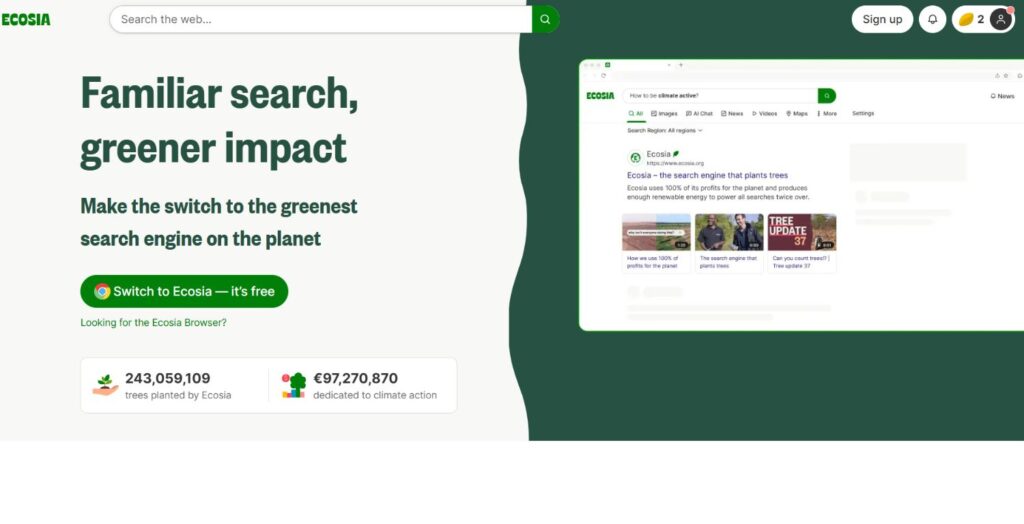
Ecosia can be considered the environmentally friendly alternatives to Google, with the advertising income planting trees across the globe. Ecosia has planted over 180 million trees in over 35 countries ever since its inception in 2009. The Berlin-based search engine releases monthly financial statements that indicate how the profit is used to reforest.
As Ecosia operates on renewable energy, the privacy of its users is preserved as permanent profiles are not created, and no data is sold to advertisers when people use the search technology provided by Bing. For users exploring eco-conscious search tools or researching Ahrefs Alternatives, Ecosia stands out as a meaningful option that blends functionality with sustainability.
What Makes it Standout:
- Plant trees globally
- Carbon-negative operations
- Financial reports on transparency.
- Renewable energy powered
- Privacy-respecting approach
Pros:
- Tracking of environmental impact.
- Simple donation mechanism
- Transparent business model
- Decent search results
Cons:
- Shows some ads
- Uses Bing index
- Limited unique features
- Tracking for analytics
Best Use Case: It is best suited to the needs of environmentally conscious users who wish its searches to contribute to climate action and reforestation of the world.
Website: ecosia.org
5. Swisscows

Type: Family-friendly search engine
Swisscows is a Swiss-based, family-friendly alternative to Google Search that emphasizes privacy and safe content filtering. It interprets user intent and context, matching keywords using semantic recognition technology and artificial intelligence.
This automatically filtered search engine is ideal for homes and schools. Swisscows does not save user data, search history, or use cookies, and is fully hosted on servers in Switzerland, where data protection laws are very strict.
What Makes it Standout:
- Semantic search technology
- In-built family-safe filtering.
- Swiss privacy standards
- No data storage
- AI-powered understanding
Pros:
- Content filtering automatically.
- Strong privacy protection
- Child-safe environment
- Intuitive semantic search
Cons:
- Limited result diversity
- Smaller search index
- The ban of restrictive content filtering
- Less popular globally
Best Use Case: Best to be used with families, schools and users who would like to be in safe browsing area, which includes automatic filters of inappropriate contents.
Website: swisscows.com
6. Qwant
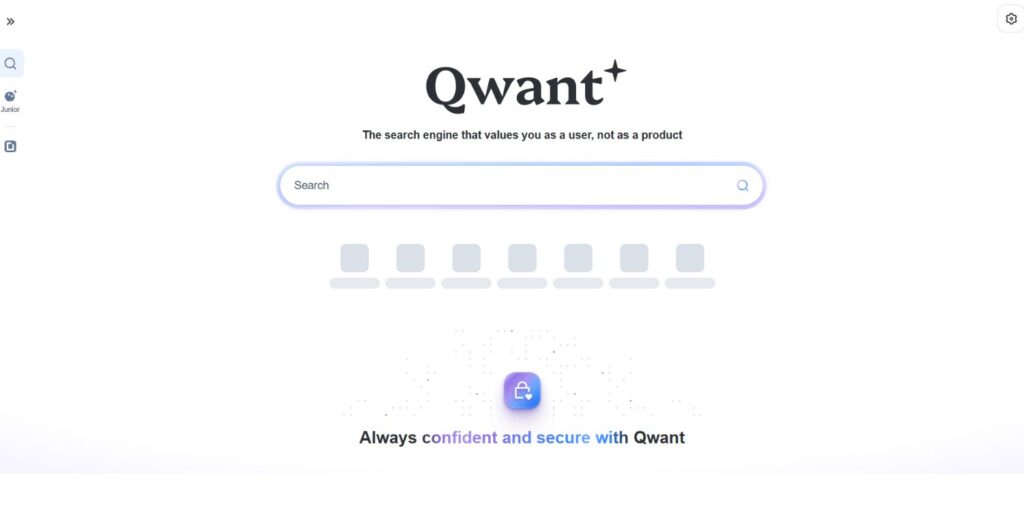
Type: European privacy search engine
Qwant is a French search engine that was launched in 2013 that claims to be the best privacy-aware engine in Europe when compared to Google. With a stringent Data protection regulation by European Union (GDPR), Qwant does not track, does not personalize search results based on search and navigation history, or build user profiles.
The search engine has a distinctive atmosphere where the web results, news, social media, and shop are shown as individual columns and provide all the necessary amount of information at once without violating the privacy of the user.
What Makes it Standout:
- GDPR compliance guaranteed
- European data sovereignty
- The results are shown in multiple columns.
- No tracking mechanisms
- Technological innovation in France.
Pros:
- European privacy standards
- Unique interface layout
- News integration included
- Social media results
Cons:
- Limited global reach
- Interface can overwhelm
- Smaller index coverage
- Less refined algorithm
Best Use Case: Suited to the needs of European users who emphasize the importance of GDPR compliance and data ownership and those who need all results of a search displayed on one screen.
Website: qwant.com
7. Yandex

Type: Russian search engine
Yandex is the biggest Russian-based search engine, and a full-fledged substitute of Google, especially dominant in the Russian speaking nations. Yandex was started in 1997 and it has since come up with advanced search algorithms that search specifically using the Russian language and the Cyrillic script.
In addition to the search, Yandex provides a wide range of ecosystem services such as maps, email, cloud storage, and transportation. Although it offers powerful searching features, and local content skills, the users are advised to remember that Yandex can be found under the jurisdiction of Russia and law of data protection.
What Makes it Standout:
- Optimization of Russian language.
- Holistic service ecosystem.
- Local content expertise
- Sophisticated translation capabilities.
- Regional market dominance
Pros:
- Excellent Russian results
- Integrated service suite
- Strong local presence
- Advanced image search
Cons:
- Russian jurisdiction issues.
- Limited Western coverage
- Privacy questions raised
- Language barriers exist
Best Use Case: Best to those who search in Russian language or those who live in Russia and other countries and need information that is localized to them.
Website: yandex.com
8. Perplexity AI

Type: AI-powered answer engine
Peruxity AI is the future search technology, as it represents an offer to become a revolution for Google, as it will simply offer answers rather than links. This AI-based platform was launched in 2022 and, based on natural language processing and machine learning, it is capable of interpreting complex queries and providing detailed and referenced answers.
Instead of scrolling through various websites, customers can get responses in the form of conversation and with the source cited, which is the best part of traditional search engines, complemented with the newest AI technologies to find information efficiently—making it a noteworthy option.
What Makes it Standout:
- Synthesis of answers created by AI.
- Source citation included
- Design of conversational interface.
- Follow-up question supports real-time access to information.
Pros:
- Direct answer provision
- Cited sources shown
- Natural conversation flow
- Time-saving efficiency
Cons:
- Potential AI inaccuracies
- Limited result depth
- Newer platform concerns
- An internet connection is required.
Best Use Case: Ideal for research, summary, finding facts, and users want ready, synthesised answers, including citations, but not lists of links.
Website: perplexity.ai
9. Wolfram Alpha
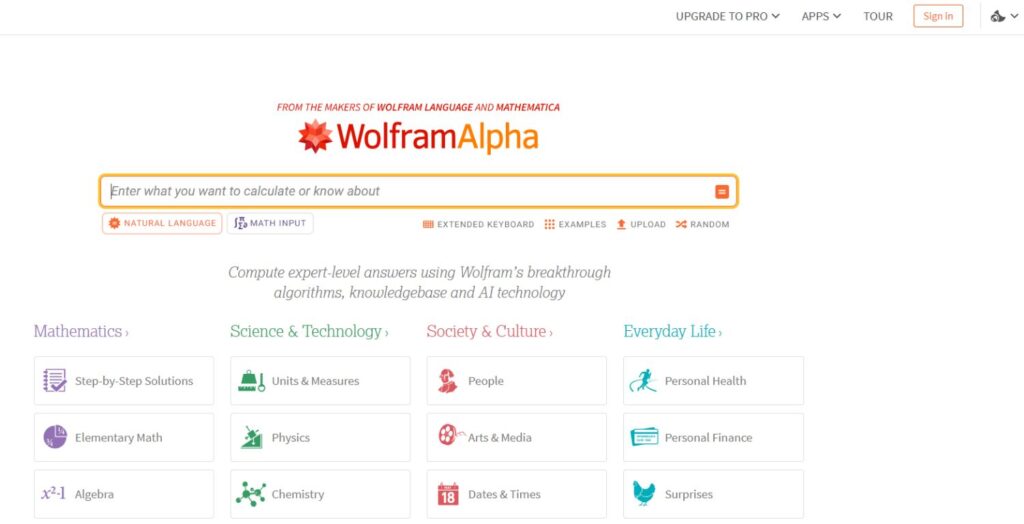
Type: Computational knowledge engine
Wolfram Alpha is an unmatched computational knowledge engine and a strong substitute for Google for technical, mathematical, or scientific queries. Wolfram Alpha is in contrast to the traditional search engines, which resolve web pages, providing answers based on its huge database of knowledge and its complex algorithms.
Released in 2009 by Wolfram Research, it is excellent at equation solving, creating visualizations, statistical analysis, and answering questions about facts in fields of mathematics, sciences, engineering, and finance, etc., with the highest degree of accuracy and depth to date.
What Makes it Standout:
- Computer generation of answers.Problem-solving in mathematics.
- Scientific data analysis
- Creation of visualization capabilities.
- Curated knowledge database
Pros:
- Accurately calculated figures.
- Educational value high
- High expertise analysis offered.
- No advertisements shown
Cons:
- Not a general search
- Limited natural language
- Paid pro features
- Niche use cases
Best Use Case: It suits students, researchers, and professionals who require the accuracy of computational solutions, mathematical tools, or scientific analysis of information.
Website: wolframalpha.com
10. Mojeek
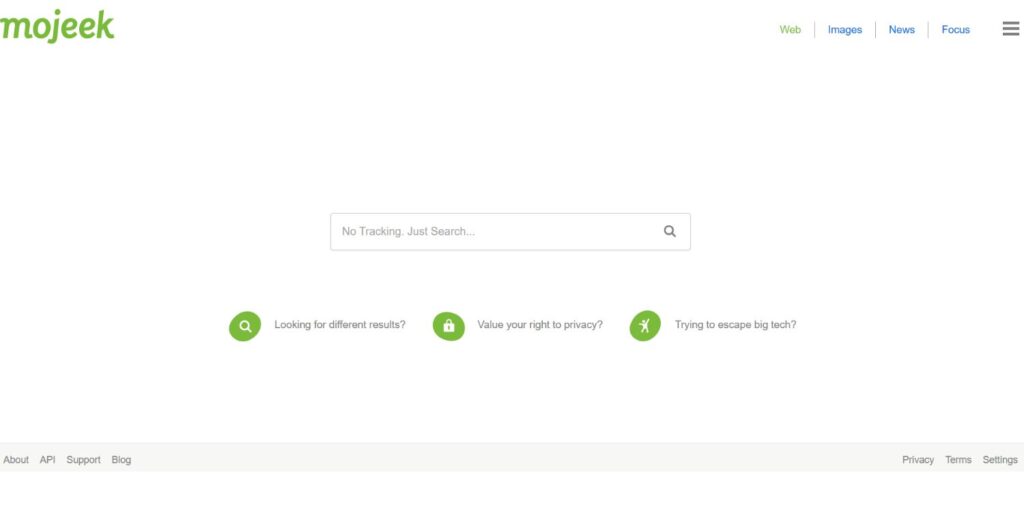
Type: Independent privacy search engine
Mojeek is a British search engine providing a veritable alternatives to Google that has an independent crawler as well as its own index, which is completely built in-house. Mojeek was founded in 2004, the first privacy-centered search engine, before making such search popular, never tracking its users or tailoring their search.
Unlike the rest of the alternatives relying on Google, Bing, or other large engines, the independent nature of Mojeek implies the real objectivity of the results. Although it has less index than the technological powerhouses, it has an enuine algorithmic resemblance in the search engine marketplace.
What Makes it Standout:
- The indexing is totally independent.
- Own web crawler
- Zero tracking commitment
- Unbiased algorithm results
- British technological self-sufficiency.
Pros:
- True search independence
- Privacy, of course, was guaranteed.
- No filter bubbles
- An alternative point of view is provided.
Cons:
- Smaller index size
- Results less refined
- Limited market share
- Fewer advanced features
Best Use Case: Best when privacy matters and those users with a desire to have a truly unbiased set of search results, not within the Google-Bing ecosystem of two search engine companies.
Website: mojeek.com
11. Presearch

Type: Decentralized blockchain search engine
Presearch is a blockchain-based decentralized search engine that is an innovative approach to Google and pays users cryptocurrency tokens as rewards for searching. This is a democratization of search that has been created as an open-source platform, focusing on redistributing power beyond the centralized corporations.
Searching using PRE attracts users to RE tokens, which they can consume internally or trade. Search Presearch combines outcomes of many sources, preserves privacy of users, and can customize search results, which means the radical upheaval of the search engine economy and regulation. For users exploring Moz Alternatives, Presearch also stands out as a modern, privacy-driven search tool offering transparency and decentralized control.
What Makes it Standout:
- Blockchain-based infrastructure
- Cryptocurrency loyalty program.
- Decentralized model of governance.
- Community-driven development
- Open-source transparency
Pros:
- Token rewards earned
- Privacy-focused approach
- Decentralized control apparatus.
- Available options of customization.
Cons:
- Complexity of the cryptocurrency.
- Still developing platform
- Smaller user base
- Results aggregated sources
Best Use Case: Perfect for blockchain enthusiasts and users who may concern themselves with decentralized technology, and would like to have an opportunity to earn some rewards when searching.
Website: presearch.com
12. Yahoo Search

Type: General web search engine
Yahoo, being driven by Microsoft Bing, is a known company that is an alternatives to Google and has a long history since the early internet era. Although the search engine used by Yahoo is that of Bing, the service has its own version of integration with the wide coverage of news, financial products and email platforms of Yahoo.
The well-known, trustworthy search results offered by the engine are in a format that highlights topical issues and popular news. Yahoo Search, despite not being privacy-oriented, is also a convenient choice to an existing Yahoo ecosystem user.
What Makes it Standout:
- Legacy brand recognition
- News integration extensive
- Email service connection
- Finance tools included
- Familiar user interface
Pros:
- Established brand trust
- In-depth coverage of news.
- Combinations of services provided.
- Reliable search results
Cons:
- Uses Bing backend
- Privacy concerns exist
- Advertisement-heavy interface
- Less innovative features
Best Use Case: The product can be used by people who are already using Yahoo Mail or Yahoo Finance and would like to have a convenient integration with the existing account.
Website: search.yahoo.com
How to Choose the Best Alternatives to Google Search Engine
- Find Your priorities: Find out what is important to you the privacy, search quality, environmental impact or special features that can fulfill your requirements.
- Compare Multiple Engines: Use various engines and test them on the queries you normally use to compare their search results, performance, and user friendly nature.
- Also keep in Mind Privacy Needs: Evaluate your data privacy necessities according to your habits of web-browsing, work requirements, and how comfortable you are with monitoring.
- Assess the Quality of Results: Other Compare the accuracy and relevancy of results on different platforms based on your personal interests, whether searching on general searches or technical ones.
- Check Special Features: Find features such as instant answers, calculation tools, or language support that match your usage habits.
- Review Business Model: Select to learn how engines generate revenue and how their advertising, data collection, or monetization policies impact your values..
Future Trends in Search Engines
- AI Reaction Strengthening: The application will utilize AI to deliver conversational replies, context perception, and customized help, and also enjoy a robust privacy threshold.
- Privacy Becomes the Norm: The demand of users will transform zero-logging and transparency into a common feature, and high-quality data protection into a high-end feature.
- Decentralized Technologies: Blockchain and distributed systems will provide a decentralized community-run platform, with less corporate power and information democratized.
- Niche Search Engines: Niche search engines that serve specific industries and communities will provide more experience than general-purpose search engines can.
- Environmental Responsibility: Ethical and environmentally responsible services, which are carbon neutral and social impact, will be a competitive advantage as users select such services.
Conclusion
By choosing a different approach to Google, users of the internet get a gateway to explore a variety of alternatives that give them an opportunity to be more privately informed, find information free of partisanship, or have novel functionalities.
Regardless of whether you prefer DuckDuckGo because of its high privacy level, Ecosia due to its positive effect on the environment, Perplexity AI because of intelligent answers, or any other substitute for Google, you are making the digital world a healthier and more diverse place.
The mentioned search engines have their own strengths that are differentiated according to their needs and values. Near monopoly by one search engine poses a threat to privacy, innovation, and the diversity of information.
Your action in diversifying your search frequency and contributing to other platforms can help to create a more competitive, more open, and user-centric internet in the future. Spend some time and visit alternatives to Google, discover what suits you best, and have a search experience that matches your priorities and principles.
FAQs
Is it necessary to change Google?
The alternatives are not obligatory, but they provide a higher degree of privacy, reduced tracking, and the provision of a fully functioning ecosystem of the internet with similar perks to search.
Can the other search engines provide worse results for me?
Not always. Startpage performs Google search confidentially, whereas DuckDuckGo and Brave Search have been able to give great and objective outcomes to most searches.
Is it possible to use several search engines?
Yes! Use a privacy engine to find personal information, Wolfram Alpha to ask technical questions, and AI platforms to conduct research, whatever is appropriate.
Can privacy-oriented search engines be considered as being private?
Yes. It has reputable alternatives such as DuckDuckGo, Startpage, and Brave Search that are transparent and audited, as well as have a proven record of no-tracking.
What are the ways free search engines become profitable?
Contextual advertising, affiliate relationships, extra capabilities, cryptocurrency incentives, or, in the case of Ecosia, the use of ad revenue to do social good.