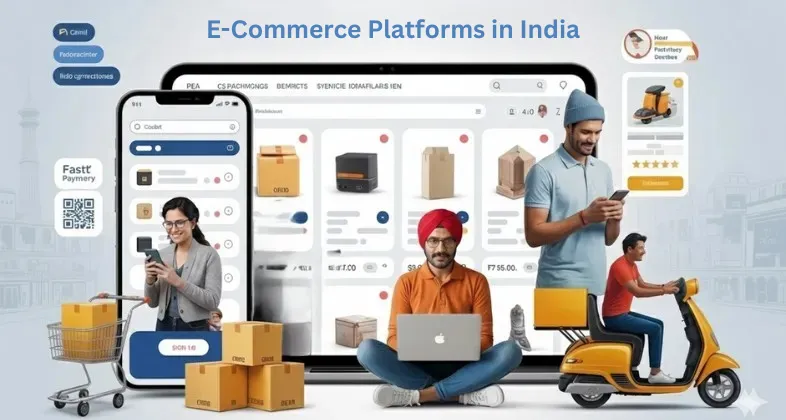
The Indian retailing landscape has undergone a seismic change and is no longer dependent on traditional brick-and-mortar models, but instead operates within a hyper-connected digital ecosystem driven by technology and mobile access. Today, E-Commerce Platforms in India form one of the most dynamic and fast-evolving retail environments globally, supported by affordable internet access and a vast, mobile-first population.
This digital shift is no longer limited to metropolitan elites; it has expanded deeply into Bharat, with Tier-2 and Tier-3 cities emerging as major contributors to online economic activity. For the modern Indian consumer, online shopping is no longer viewed as a luxury experience but as a daily utility, covering everything from emergency medicines to customized furniture.
The scale of this transformation is reflected in the industry’s exceptional growth and expanding user base. Market projections indicate that India’s e-commerce sector is moving toward a multi-hundred-billion-dollar valuation, driven by rapid digital adoption and increasing consumer trust. At the same time, the number of online shoppers continues to rise sharply, pointing toward a future where a significant portion of the population engages in digital commerce. These trends highlight a fundamental shift in consumer behavior, where speed, convenience, trust, and hyper-localized services have become the new pillars of retail success.
What is E-Commerce?
Essentially, e-commerce (electronic commerce) involves the purchasing and selling of goods and services through the internet. It has developed into a multidimensional contact point in the Indian scenario, where transactions occur among several types of e-commerce:
- B2C Business-to-Consumer: The most prevalent type, in which services such as Amazon and Flipkart focus on selling directly to the ultimate consumer.
- B2B (Business-to-Business): There are bulk markets, such as IndiaMART, that are used to find retailers and manufacturers.
- C2C (Consumer-to-Consumer): Customer-to-customer auctioning sites on which people sell to each other.
- Quick Commerce (Q-Commerce): A specialized brand characterized by incredibly fast delivery (less than 15 minutes), transforming the grocery and everyday needs purchase model in urban India.
List of 15 Best E-Commerce Platforms in India
1. Amazon India
Website: http://amazon.in
Amazon India is the Indian e-commerce giant that shows more than 211 million monthly visitors. It is no longer focusing on volume, but on profitability through efficiency, as it recently reduced referral fees on sub-₹300 items in order to give power to small-scale sellers. The Prime ecosystem is its foundation of success, which provides integrated value through streaming, music, and guaranteed same-day delivery, building strong customer loyalty.
Amazon now has many more fulfillment centers spread into rural areas, ensuring that the Prime experience is no longer limited to metro cities. There has also been the introduction of enhanced AI shopping assistants on the platform that enable users to search for products in regional languages and even through images drawn by hand.
Pros:
- Superior logistics system that is fast and reliable across all regions in the country.
- Large product assortment of rare collectibles/ everyday goods.
- Interactive intelligent search and customized stores.
- No referral charges on cheap necessities sold by sellers (sub-[?]300).
- Very safe payment gateway through Amazon Pay.
Cons:
- Fatigue caused by the significant number of sellers of the third party.
- The sellers have to pay more to be seen.
- Scattered quality discrepancy in unapproved third-party listings.
- Older smartphones may be heavy in terms of interface.
2. Flipkart
Website: http://flipkart.com
Homegrown giant supported by Walmart, Flipkart remains a key destination for smartphones and electronics and holds the largest market share in these two categories among e-commerce platforms in India. The platform has successfully shifted toward value commerce, reaching the Bharat population through regional language interfaces and voice-based shopping.
Its Big Billion Days continue to be the biggest shopping event in the country and often set annual sales benchmarks for major technology brands. Recently, Flipkart has also launched Flipkart Reset, a refurbished electronics vertical offering quality used devices, aimed at tapping into the growing sustainability-conscious consumer base in urban India.
Pros:
- Strong competitor in the monopoly mobile and laptop branding.
- Extremely localized user experience and 11 or more Indian languages.
- Exemplary free EMI and product exchange schemes.
- ClearTrip and other partners with SuperCoin loyalty system.
- Good offline-online synergy via Walmart supply chain.
Cons:
- There is too much clutter with banners and advertisements on the interface.
- In the rural areas, sometimes delivery speed can fall behind Amazon.
- Very stiff price wars may result in smaller sellers having narrower margins.
- The excessive quantity of marketing messages may be obtrusive.
3. Myntra
Website: http://myntra.com
Myntra has established itself as the Style Authority in India. It has become the preferred platform for Gen Z and Millennials due to its trend-first approach and celebrity-led brand launches. The End of Reason Sale (EORS) at Myntra has evolved into a cultural phenomenon, with millions of merchandise units sold within a few hours.
The platform has implemented AR-based “Try-On” features for makeup and watches, which have helped reduce returns and increase sales for premium brands. It also offers a social-media-like content stream through its “Myntra Studio” feature, allowing influencers to showcase outfits with a single tap, seamlessly blending entertainment with retail.
Pros:
- Premier exhibition and high-end and foreign fashion brand curation.
- The program is known as Myntra Insider, where sales and free delivery are offered at an early stage.
- Very intuitive and user interface made in a way that allows visual exploration and inspiration.
- Superior return/exchange policies, especially on apparel.
- Complex AR designs of virtual trials of beauty and accessory goods.
Cons:
- This has been enabled by selective onboarding, which makes it hard to include new brands that are smaller.
- There are increased commission rates as opposed to the general marketplaces, such as Meesho.
- The extreme budget shoppers may be pushed off by the premium pricing focus.
- The process of issuing returns on high-value items may, in certain cases, take more than 7 days.
4. Meesho
Website: http://meesho.com
Meesho is a major disruptor in the Indian e-commerce space and has managed to file its IPO with a valuation of Rs. 50,000 crore. It follows a unique, asset-light model that does not rely on owning warehouses or logistics fleets, enabling it to keep prices as low as possible for value-sensitive buyers. Meesho is a leader in social commerce, where products are sold by millions of small business owners primarily through WhatsApp.
The platform records one of the highest engagement rates, with users visiting an average of 7.7 pages per session. Its zero-commission model for sellers has helped it gain popularity among nearly 1.5 million small enterprises in India that previously lacked access to a formal e-commerce entry.
Pros:
- Minimum prices in the market because of the model of zero-commission seller.
- Most efficient per staff in the Indian e-commerce business.
- Tremendous coverage in Tier-2 and Tier-3 towns.
- Streamlined registration of small and local manufacturers.
- Well-generated free cash flow when there are accounting losses generated.
Cons:
- The quality of unbranded goods can be determined by whether it works or not.
- The customer service and the return logistics is typically slower than the Big Two.
- Absence of the luxury segment among the high-end buyers.
- The descriptions of the products are usually not detailed and are generated by users.
5. JioMart
Website: https://www.jiomart.com/
JioMart is a major venture by Reliance Retail in the grocery and daily essentials segment, and it stands out among e-commerce platforms in India for delivering a powerful omnichannel experience that few global competitors can match. Leveraging more than 18,000 Reliance Retail stores as dark stores for faster fulfillment, its integration with WhatsApp has made online shopping more accessible for millions of non-technical Indians, allowing them to chat and shop directly from their local kirana stores.
JioMart has also evolved into JioMart Digital, a service that enables customers to purchase electronics that are delivered and installed by the nearest Reliance Digital store within 24 hours, effectively combining local trust with digital convenience.
Pros:
- Considerable coverage on the pre-existing Reliance physical retail network.
- No-questions-asked” policy of refusing back fresh produce.
- User friendliness through WhatsApp to order groceries.
- Prices on the daily staples and cooking oils are competitive.
- Expanding electronics and lifestyle divisions sponsored by Reliance Digital/Trends.
Cons:
- The interface of the application is less refined than Amazon’s.
- Local stores and the app may sometimes fail in the normalization of inventory.
- Mixed opinions about the freshness of produce in non-metro.
- Digital item customer care response times may not be optimal.
Also Read: SEO Strategies for B2B Companies
6. Nykaa

Website: http://nykaa.com
In India, Nykaa is the gold standard in the beauty and wellness space. It has continued to stay ahead by focusing strongly on authenticity, a critical factor in a market flooded with counterfeit cosmetics. Its omnichannel business model, supported by more than 100 physical retail stores, allows customers to try before they buy, while its Nykaa TV content engine delivers beauty tutorials that directly drive sales.
The platform has also expanded into the male grooming segment through Nykaa Man, targeting a rapidly growing market, and into premium apparel with Nykaa Fashion, which focuses on curated high-end boutique wear rather than a mass-market approach.
Pros:
- Ensured the authenticity of the international luxury beauty brands.
- Artificial intelligence-powered skin care and make-up suggestions.
- Powerful in-house brands (Kay Beauty, Nykaa Cosmetics) with high margins.
- Combined content-ecosystem (tutorials/guides) improves user dwell-time.
- Extra-loyal customers with a Millennial urban and high-spending consumer base.
Cons:
- Expensive marketing and customer acquisition rates.
- Less penetration in Tier-3 markets than in the mass-market apps.
- Temperature-sensitive inventory is making its operations complex.
- Not many discount offers on off-peak days other than their semi-annual Pink Friday.
7. IndiaMART
Website: http://indiamart.com
IndiaMART is the largest B2B e-marketplace in India, connecting millions of buyers and suppliers across the country. It plays a crucial role in supporting the SME sector and facilitates trade across categories ranging from bulk chemicals to industrial machinery. The platform is debt-free and highly profitable, although it faces challenges in retaining subscribers as niche B2B startups continue to emerge.
IndiaMART has launched IndiaMART Pay to enable secure transactions between small manufacturers and buyers, acting as an escrow service to build trust in an otherwise uncertain wholesale ecosystem. It remains an important tool for Indian exporters seeking reliable local suppliers of raw materials.
Pros:
- The biggest manufacturers and wholesalers database in India.
- The linkage with the suppliers is direct without using many of the middlemen.
- Categories covered are very wide, such as industrial and raw materials.
- An intense lead-generation network in the near future with small-scale exporters.
- Debt-free and profitable financial structure.
Cons:
- Low retention level among subscribers.
- It is industrialized and not streamlined to a silky-looking retail interface.
- Takes a considerable amount of manual negotiation for price and shipping.
- This can be spam by various suppliers on one inquiry.
8. Ajio

Website: http://ajio.com
Ajio is a competitor to Myntra developed by Reliance, and it stands out among e-commerce platform in India by offering a mix of indie brands and global streetwear. Its Ajio Luxe segment has emerged as a leading destination for premium fashion, making luxury more accessible to the Indian middle class.
The All-Stars Sale has grown into a major industry event, featuring high-value rewards such as iPhones and MacBooks for top customers. The platform strongly appeals to Gen Z hypebeasts through its bold, high-fashion positioning and a sharp focus on exclusive international brands that are not available on Flipkart or Amazon.
Pros:
- Expert selection of the regional Indian “Indie” and artisanal fashion.
- Ajio Luxe introduces high-end fashion in the world to a wider market.
- Price competition on fashionable, young collections.
- Good marketing of upcoming Indian designer brands.
- locates products that are metro-delivered, with most of its products.
Cons:
- A smaller reach in smaller towns is still lower compared to Myntra.
- When the sales are heavy, the performance of the application might be slow.
- New brands can face the challenge of selective onboarding.
- In semi-urban areas, the services of returning the pick-ups can be unreliable.
9. FirstCry
Website: http://firstcry.com
FirstCry is the largest baby and kids products platform in Asia. It holds a strong advantage as a specialist brand with a wide product range that spans from strollers to maternity clothing. With a presence in more than 30 cities and thousands of brick-and-mortar stores, it offers a sense of trust, security, and community that many competitors lack.
FirstCry has also expanded into FirstCry Intelitots, a platform that integrates its retail ecosystem with early childhood education services and parenting guidance, positioning the brand as a long-term lifecycle partner for new parents.
Pros:
- One-stop shop for all the childcare and maternity needs.
- Membership of the club offers a lot of savings on repetitive necessities.
- The factor of trust is also high as there is specialized attention to child safety.
- Awesome omnichannel strategy ( Online + Physical Stores).
- Vigorous parental community and advice blog assimilate.
Cons:
- The stock of special international toy brands is not always constant.
- The interface of the site could be crammed with categories.
- Prices of shipping products that have a low value are usually expensive.
- Quality products may be much more costly than generic products.
10. Tata CLiQ
Website: http://tatacliq.com
Tata CLiQ is a platform that prioritizes quality over quantity. Its phygital model allows users to shop online and conveniently pick up or return products at physical brand stores. Backed by the strong brand equity of the Tata Group, it is widely trusted for authentic electronics and premium fashion.
The platform avoids the typical marketplace feel of its competitors by onboarding only authorized brand sellers, ensuring that every product delivered is certified as original. This focus on authenticity has made Tata CLiQ a preferred destination for high-end watches, electronics, and luxury skincare products.
Pros:
- Full assurance of authentic products of the best brands across the world.
- The ease of returning to a store is offered by the phygital model.
- The selected marketplace guarantees high-end shopping.
- Great place to go to have high-end luxury fashion (CLiQ Luxury).
- The Tata brand is trusted, which guarantees a high level of consumer confidence.
Cons:
- The overall user base is smaller than that of Amazon or Flipkart.
- Focusing on niche audiences implies low appeal by the mass market.
- Choosy brand catalogue can be repressive.
- Luxury goods might require more time to be delivered because of the additional quality control measures.
11. Snapdeal
Website: http://snapdeal.com
Snapdeal has redefined itself as India’s largest pure-play value e-commerce platform. It focuses strongly on Tier-2 and smaller cities, offering lifestyle products that are typically priced below Rs. 1,000. Its asset-light business model and AI-driven personalized product discovery have helped it maintain a steady base of over 50 million transacting users.
The platform specializes in fast-moving, low-margin home and kitchen products and sources directly from manufacturing hubs such as Tirupur and Surat, enabling Bharat consumers to enjoy market-like pricing.
Pros:
- Very cheap, low-cost product portfolio.
- The logistics model of asset-light is a guarantee of delivery throughout the country.
- High emphasis on “Bharat” through the multi-lingual support.
- Artificial intelligence-based discovery shopping.
- Affordable pricing of home and kitchen generic goods.
Cons:
- Poor brand image in comparison with the horizontal giants.
- Low-cost focus makes stressed building of premium trust difficult.
- The expectations of quality increased the rates of return.
- Not as sophisticated as the Nykaa or the Myntra apps.
12. BigBasket
Website: http://bigbasket.com
BigBasket is India’s most well-known online grocery platform and is now part of the Tata Group. It follows an inventory-led model and operates in more than 30 cities, handling around 15 million orders per month. This approach ensures superior quality control and freshness compared to marketplace-based models.
BigBasket also offers ultra-fast delivery through its BB Now service, delivering essentials within 15 minutes. The company has successfully expanded into categories like BB Beauty and BB Home, using its existing delivery infrastructure to distribute higher-value items such as cosmetics and home appliances alongside daily groceries like milk and vegetables.
Pros:
- High quality and freshness is ensured in the inventory-led model.
- Close ties with farmers give pricing authority and discretion.
- bbnow offers a pop-up delivery service on urban essentials that takes 10-20 minutes.
- Extensive assortment (20,000 or more items) with specialty organic selections.
- Infrastructure in the cold chain leads to improved product shelf-life.
Cons:
- Free delivery requires a minimum order value, which is usually high.
- Regular savings must be nearly subscribed to (bbStar).
- These delivery slots might be booked early, especially during high rainy seasons.
- The huge amount of SKUs may make the App sluggish.
13. Pepperfry
Website: http://pepperfry.com
Pepperfry is a leading destination for online furniture and home décor in India. It has transformed the category by establishing modern Pepperfry Studios, where customers can consult interior designers and complete their purchases online. The platform is known for offering everything from ergonomic gaming chairs to custom-built solid-wood sofas.
Its website uses advanced room visualizers that allow customers to see exactly how items like a six-seater dining table will fit into a specific apartment layout using a smartphone camera. Pepperfry also provides specialized white-glove delivery, ensuring that heavy furniture is delivered, installed, and fully unpacked in a single visit.
Pros:
- Furniture leader in furniture with high-quality 3D and AR trial.
- The physical touchpoints that are important are the studio Pepperfry locations.
- Propositions specialized in the assembly and installation of heavy items.
- Great product diversification in low and high-end.
- Much emphasis on ergonomic designs of home-based offices.
Cons:
- Large items can be delivered within 10-15 days.
- Bulk furniture shipping and returns are costly.
- This type of niche focus is not applicable to general household shopping.
- Lower-end modular furniture is inconsistent in its quality.
14. Lenskart
Website: http://lenskart.com
Lenskart is the unquestioned market leader in Eyewear, with more than 2,700 stores and a strong online presence among e-commerce platforms in India. It manufactures its own frames and lenses in Rajasthan. Through its service Home Eye Check-up, it has provided access to the professional eye care of millions of Indians.
Their Virtual 3D Try-On is based on face-mapping technology, which suggests frames based on face shape and pupillary distance with an accuracy that has significantly lowered the returns that were traditionally linked to prescription eyewear.
Pros:
- High quality and low costs are guaranteed by a vertically integrated model.
- With Home Eye Check-Up, a professional optometrist comes to your door.
- Virtual 3D try on is the most superior in the industry.
- Gold membership deals such as Buy-One-Get-One (BOGO) are a huge HIT.
- Automatic alignment of orders online with store adaptations.
Cons:
- Rude marketing communications are obtrusive.
- Getting much emphasis on the house brands (Vincent Chase, Lenskart Air).
- It is also prone to economic lows because it is concentrated on discretionary spending.
- Complex high-index lenses can require more than 10 days to deliver.
15. Blinkit

Website: http://blinkit.com
Blinkit (a part of Zomato) is the first one to introduce Clean-Cut in India. Offering groceries and essentials within a time of less than 10 minutes, it has seen an incredible 156% annual increase. It has more than 1,500 dark stores that serve the I-want-it-now target audience in the city, which provides milk to iPhones within record time.
Blinkit has also launched Blinkit Print, enabling users to scan and get their documents printed and delivered to their doorsteps within a very short timeframe, further cementing the already established urban logistics life-saving service.
Pros:
- India. The quickest delivery service (less than 15minutes).
- Enormously streamlined logistics and a large dark store network.
- Minimalised, consumer-focused application interface.
- A bigger selection of products, such as electronics and cosmetics.
- Tracking and good ETA forecasting.
Cons:
- Long-term profitability may be influenced by the high operational costs.
- The cost of delivering and platforms for small orders is high.
- The choice is also poorer thanthe inventory-harvesting BigBasket.
- The problem of out-of-stock is frequent during peak time.
Feature Comparison & Strategic Breakdown
| Rank | Website | Primary Niche | Engagement (Pages/Visit) | Best For |
| 1 | Amazon India | Horizontal | 5.52 | Electronics & Variety |
| 2 | Flipkart | Horizontal | 5.20 | Mobile Phones & Sales |
| 3 | Myntra | Fashion | 4.70 | Branded Style |
| 4 | Meesho | Value Fashion | 7.73 | Affordable Unbranded |
| 5 | JioMart | Grocery | 4.81 | Fresh Essentials |
| 6 | Nykaa | Beauty | 3.51 | Authentic Cosmetics |
| 7 | IndiaMART | B2B Wholesale | 4.29 | Bulk & Industrial |
| 8 | Ajio | Indie Fashion | 2.80 | Regional & Street Style |
| 9 | FirstCry | Baby & Kids | N/A | Toys & Maternity |
| 10 | Tata CLiQ | Premium/Lux | 2.86 | Authentic Brands |
| 11 | Snapdeal | Value | N/A | Budget Home Goods |
| 12 | BigBasket | Grocery | 2.06 | Large Weekly Stocking |
| 13 | Pepperfry | Furniture | N/A | Home Decor & Office |
| 14 | Lenskart | Eyewear | 2.98 | Glasses & Eye Checks |
| 15 | Blinkit | Quick Comm | N/A | 10-Minute Emergencies |
Final Verdict
The Specialization and Localization strengths lie in the Indian e-commerce scenario. Although Amazon and Flipkart are still the pillars of overall shopping amonge-commerce platforms in India, the noisy development is observed with Quick Commerce (Blinkit) and Value Commerce (Meesho). The Indian consumer has grown up: now, they are seeking authenticity in beauty (Nykaa), a feel in furniture (Pepperfry), and instant satisfaction in groceries (Blinkit).
The market no longer favours most products, but simply the one that results in the solution of the particular daily friction of the Indian household. The combination of 5G, Augmented Reality, and Vernacular AI in the future will continue to blur the lines between online and offline shopping, and the digital store blackout will become an unavoidable component of the life of any Indian.
FAQs
What is the most popular e-commerce Indian site?
Horizontal websites have shown that Amazon India is the most visited and then Flipkart.
Which is the most suitable place to find cheap fashion?
Meesho is a brand that comprises value-based unbranded fashion in Tier-2 and Tier-3 cities.
What is the quickest platform to deliver on?
Blinkit is the head of Quicker-commerce, which is delivered within less than 15 minutes in cities.
Is IndiaMART open to ordinary shoppers?
No, it is mainly a B2B system that comes with bulk purchasing and manufacturing links.
What is the most effective e-shopping place for luxury beauty goods?
Nykaa has the most trusted brands of authentic international and high-quality beauty brands.