

Let’s be honest for a second.
There is a graveyard of content on most websites: old blog posts that are never read, pages that are ranking on the wrong keywords, and articles that were once good three years ago and now seem to be ancient history.
Sound familiar?
You’re not alone. Most of the website owners waste time and money on new content creation yet their greatest chance is right there in the old content, buried in the old.
That is where a content audit is introduced.
And glancing at you, before you consider that this is some technical kind of job the SEO experts are only supposed to perform, it is not. This handbook will talk you through it all in simple terms. No confusing jargon. Not a lot of dreadful spreadsheets (not too many).
The following are just a few figures that ought to put you to serious consideration at this moment:
It is not always necessary to publish more new content to unlock approximately 80 percent of future traffic and conversions of a site, since the top-performing 20 percent of pages will often unlock more opportunities.
The most accurate meta description can result in a higher click-through rate (CTR) (2026 statistics) by up to 43 percent.
The number of Zero- click searches has increased by 56 percent to 69 percent in the years 2024 to May 2025- the content you create now has to perform better rather than appear during higher ranking.
The percentage of websites achieving all three Core Web Vitals on mobile is 48% as of 2025 – a technical problem that a decent audit will identify instantly.
Those figures are testimony to one thing, namely, what you have already written is worth more than what you are just going to write. Let’s make the most of it.
What Is a Content Audit?
A content audit is a methodical analysis of all content on your site, blog posts, landing pages, and product pages, etc., to determine the extent to which each specific piece is working and what to do with it.
Consider it as a check up on your site. A content audit means you are going to look at what you already do, rather than passively publishing new material and wishing it succeeds, and asking yourself: Is this generating business? Or is it just taking up space?
It is not only aimed at finding what is broken. It is to find the opportunities that are buried down the page, or the post that is just attracting the wrong people, or the post that could be generating actual conversions with a little specific editing.
The right content audit usually considers three factors: SEO results (can this page rank and get the appropriate traffic?), quality of content (is the data true, relevant and actually valuable?), and business value (is this page helping towards your real objectives?).
Types of Content Audits
Not all audits have to be comprehensive. These three types will be run depending on your intentions:
SEO-Focused Audit
This narrows down to the performance of your content in search. You are viewing key word targeting, meta-tagging, internal links as well as organic traffic patterns. It is hoped to locate those pages that can be optimised to be ranked higher, get more qualified visitors or get featured snippets.
Content Quality Audit
This is regarding the content of what you have written. Are the facts still accurate? Is it the correct tone of your audience? Does the information provide an answer to the question that a reader has? The quality audits are particularly useful with old sites whose three or four years old posts might have become obsolete or may have just been overtaken by the competitors.
Technical Audit
This is concerned with the structural well-being of your pages, broken links, long load times, lack of meta description, mobile usability problems, and Core Web Vitals. Technical audit frequently contributes to an SEO audit, as, however much is written well, it is of no use on a page that cannot be crawled and indexed correctly by search engines.
How to Do a Website Content Audit (Step-by-Step)
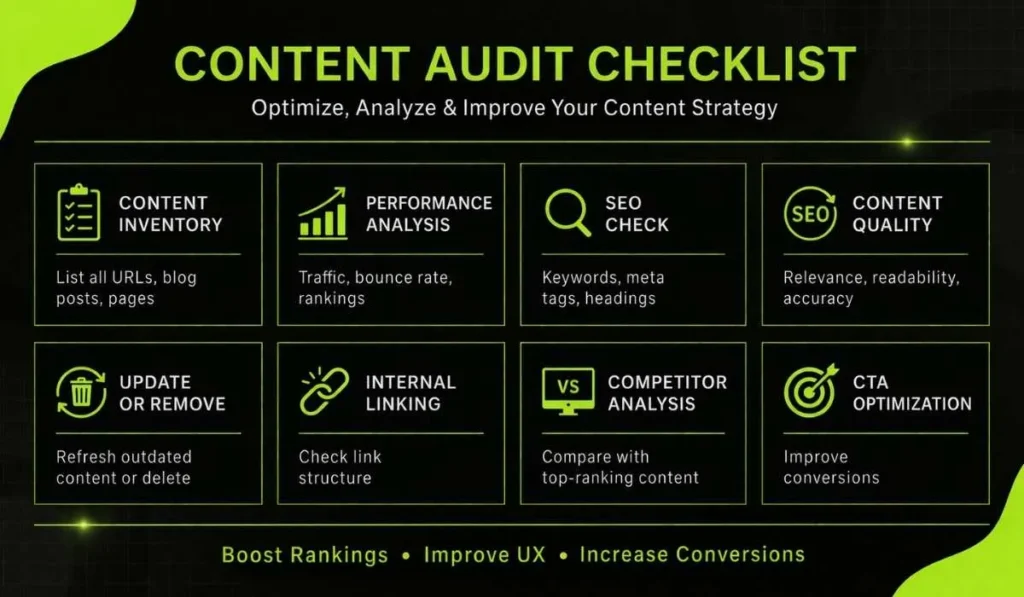
This is one of the straightforward steps that you can repeat and take, no matter the size of your site.
Step 1: Explore Your Site and create a Content inventory
You should have a full list of all the URLs in your site before you can audit anything. Crawl your site with an application such as Screaming Frog (free to 500 URLs) or Sitebulb and then save all of the live pages in a spreadsheet. This is your grand list, your master list: on this all the rest is hinged.
Step 2: Extraction of Your Performance Data
Relate your inventory to actual data. Google Search Console (impressions, clicks, average position, CTR) and Google Analytics 4 (sessions, bounce rate, conversions) metrics of each URL. You do not make decisions using your gut feeling; you are making them using the numbers telling you what they are really saying.
Step 3: Categorise Every Page
In the case of every URL, one of four actions is assigned:
The page is doing well and does not require any urgent modifications.
- Enhance – The page is promising, but requires renovation, more optimisation, or fresh content.
- Consolidate – The page overlaps a lot with another page, and they need to be consolidated.
- Cut – It is a dead page with no traffic, no backlinks, no business value, and no viable way of coming out. Redirect or delete it.
This is the point where the majority of the actual thinking occurs. Be honest. A page that has been visited three times in six months and has nothing to sell is not a maybe — it is a deletion.
Step 4: Conduct a Quality and technical check
In each of the pages that you have already marked as Keep or Improve, go through the checklist discussed in the following part of this guide. Peruse through the old statistics, broken links, missing or weak meta descriptions, slow load time, and mobile display problems. Note down all that needs to be paid attention to and put this in your spreadsheet against the corresponding URL.
Step 5: Prioritise and come up with an Action Plan
You are now clear about your site. The final thing is making a decision on the first thing to address. Begin with your most visited pages – it is on these where you can get the most out of a time spent. Then go to pages that are ranking in page two or three of Google, and are near breaking through with a few specific things fixed. Shelf low-priority clean-up tasks.
Content Audit vs Content Inventory
These two are confused by people. Here’s the simple difference:
A content inventory is simply a list. It is you that say: Here are all the pages I have on my web page. That is all, analysis, judgment.
A content audit goes further. It puts that list and then inquires: “Okay, what is the performance of each page? What’s working? What’s dead weight?” It incorporates measures, setting, and action plans.
Imagine the inventory is your grocery list, and the audit is going to see whether the food in your fridge is good to eat or not.
Content Audit Checklist (Action List)
This checklist is created so that you can use it whenever you conduct an audit.
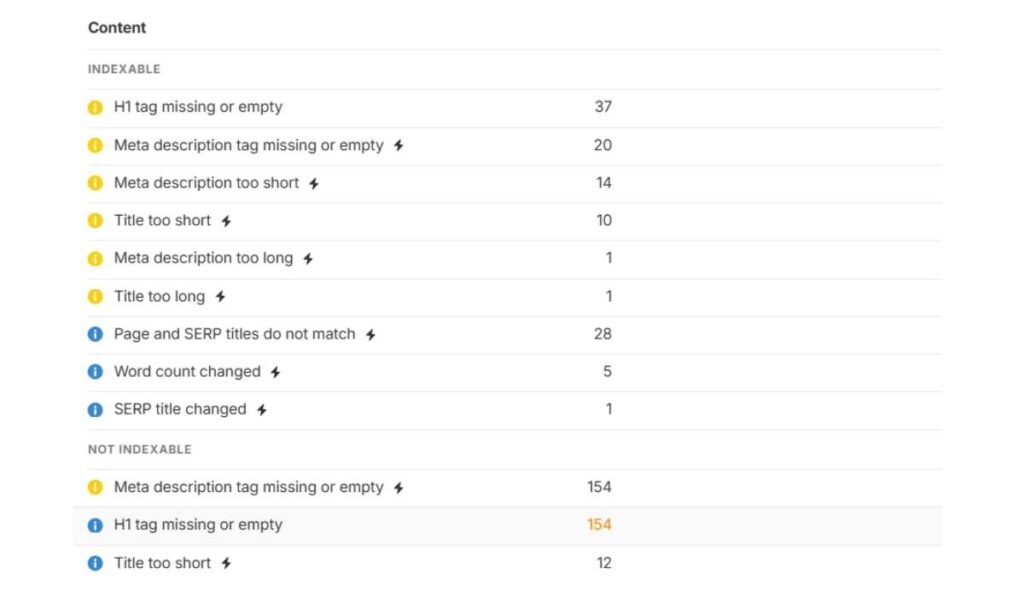
SEO Checklist
Keywords optimized
- Are there any definite primary keywords of the page?
- Do the keywords used in the title, first paragraph, and some subheadings make sense?
- Do you aim at long-tail variations? Long-tail coverage is essential; (Ahrefs says, of course, that 70 percent of queries contain more than four words).
Meta tags present
- Does the meta title contain more than 60 characters and is keyword-rich?
- Does the meta description not exceed 155 characters and is written to stimulate clicks?
Note: meta description can optimize a CTR by 43% – this is just one minor adjustment that makes a significant difference.
Internal linking
- Does this page have the related information on your site?
- Are there any other related pages that go back to this page?
- Does it have any orphan pages (pages that have no internal links to them)?
Content Quality Checklist
Matches search intent
- Would a person searching the keyword you are targeting have all of their questions answered by this page?
- Is the format of the content what Google displays in the first results (e.g. guide vs. list vs. tool)?
Updated information
- Is everything still true in terms of statistics, numbers, and examples?
- Are they of outdated reference, have broken links to products, or irrelevant mentions?
- Does the page contain any updates within the past 12 months?
Readability
Are the sentences concise and clear?
- Does it have subheadings where there are long sections?
- Does it actually write as though it were written to the reader, not to Google?
Technical Checklist
Broken links
- Are any outbound links in the page resulting in 404-errors?
- Is it an individual page that is returning a 200 status code?
- Do all of the image files load correctly?
Page speed
Does it load its page within 3 seconds? It will cost you a lot of your potential visitors to have a site that takes over three seconds to load. The speed of a conversion can be decreased by 20 percent in just a second of time lag.
- Are images compressed?
- Are there any render blocking scripts that slow-down the performance?
Mobile friendliness
- Is the page well displayed on phones and tablets?
- Can easily be tapped on a small screen: button/links?
It is also the case that mobile users constitute over 70 percent of web traffic, and in case your pages are not mobile-friendly, you are losing most of your potential clients.
Performance Checklist
Traffic
- What was the level of organic traffic received by this page in the previous 90 days?
- Is the traffic on an upward trend, flat, or on a downward trend?
CTR (Click-Through Rate)
- What is the average CTR of this page on the Search Console?
- Is it below 2%? Provided so, the title or meta description should probably require some work.
Conversions
- Does this page result in any action (sign-ups, purchases, or fills of a contact form)?
- Does the reader have a definite follow-up?
Best Content Audit Tools (Free and paid)
You do not have to spend a lot to conduct an effective audit. Here’s a quick breakdown:
Free Tools:
- Google Search Console – Necessary in impressions, clicks, CTR, and crawl errors. No reason not to use this.
- Google analytics 4 – Displays user data, sessions, bounce rate and conversion.
- Screaming Frog (frees up to 500 URLs) – crawls your site and resolves broken links, duplicate content, missing meta tags and so forth.
- Google PageSpeed Insights – Checks your page speed score and Core Web Vitals.
Paid Tools:
- SEMRush – All-in-one software to track keywords, analyze content audits, examine backlinks, and research competitors. It was one of the most loved options among the SEO specialists.
- Ahrefs – The best tool to use on backlink data, ranking of the keywords, and the gap in the content.
- Screaming Frog (paid, £199/year) — It is the gold standard in technical crawling since there are over 500 pages.
- Analytify – Specifically to WordPress users, this tool is designed to present their Google Analytics data in a cleaner and simpler dashboard within WordPress itself.
How Often Should You Perform a Content Audit?
There is no clear answer to this, but these are some practical guidelines:
- After 6 months, it applies to most of the small to medium-sized websites. This is quite sufficient to snatch falling pages and refresh key content before ranks suffer too much for too long.
- Every 3 months – Websites with frequent publications are in a competitive market, or actively attempt to expand organic search traffic.
- Every month – To large sites with hundreds of pages, e-commerce sites, or businesses with fast-moving industries.
Content Audit vs SEO Audit
The question that is asked is: Are these not one and the same thing?
Not quite.
The content audit is concerned with your real material – the words, the subjects, the quality, the form, the topicality. It provides the answer to the question: Am I saying anything really valuable and true?
An SEO audit is broader. It encompasses the technical problems such as the speed of the site, its crawlability, redirects, schema markup, errors on the server, Core Web Vitals, and others. It contains the question: Is it possible to make search engines find, comprehend, and rank my pages correctly?
You can imagine the SEO audit is the foundation, and the content audit is a structure that is built on top of it. Both are necessary. Without the correct crawling, rendering, and indexing of key pages, subsequent-level optimisations, including superior ones, will stagnate.
Any technical audit should be completed first to correct any crawling or indexing problems, and then a content audit should be completed to optimize what is actually on the pages.
Conclusion
The term content audit may be quite frightening and appear to be a massive assignment. However, to its core, it is simply a matter of telling oneself the truth: What works on my site, and what does not?
The positive aspect is that there is much content to be saved on even those websites that seem to be stuck. They only require some care, some revising and a bit of tactical reasoning.
Run a content audit. Choose three of your favorites of sleeping giant pages. Provide them with recent information, improved headings, and an improved meta description. Then watch what happens.
It does not have to be good on the first try. It just needs to start.
Have you performed a content audit previously? What is the single page on your site that you are aware of that needs updating? Leave a comment below here — or forward this article on to a person whose Website might need to be cleansed.
FAQs
How time-consuming is a content audit?
It depends on your site size. It may require a few hours on a small blog that has 50 pages. A big website that has 500 or more pages may require a few days. The correct tools, such as Screaming Frog and Search Console, make it a lot faster.
Do I have to have technical skills in order to do a content audit?
Not really. The simple actions, such as drawing URLs, measuring metrics, and classifying pages, can be accomplished using free tools and a simple spreadsheet. No coding required.
What is the initial step that I need to do after a content audit?
You can start with your top 10-20 pages in terms of visits. Ensure that they are correct, well-organized, and optimized. The highest volume of traffic is generated by these pages; therefore, the ROI of fixing them is the best.
Is it possible to perform a content audit of a new site?
In the event that your site is less than 6 months old and fewer than 20 pages, your site does not need a formal audit at present. Publishing high-quality content initially, and auditing when you have sufficient information to process.