
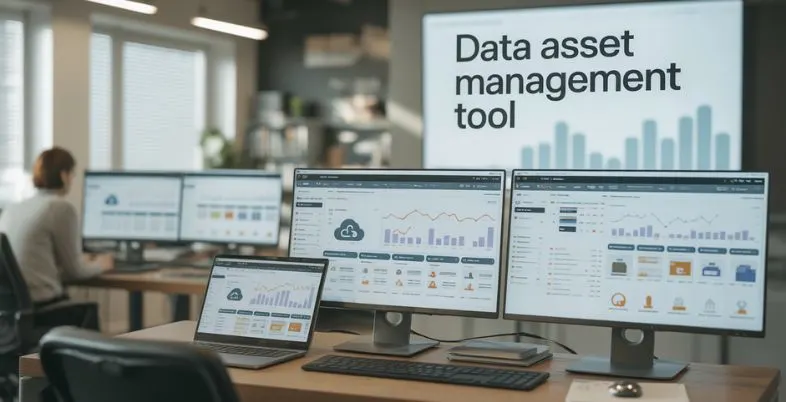
Data Asset Management Tools help organisations discover, organise, govern, and maximise the value of their data across its entire lifecycle. As businesses generate data from multiple sources—cloud platforms, applications, and connected systems—managing these assets effectively becomes critical for accuracy, security, and compliance. These tools provide a centralised view of data assets, including metadata, ownership, usage, and quality, enabling teams to understand what data exists and how it is used.
Modern Data Asset Management Platforms go beyond simple cataloguing by offering automated data discovery, lineage tracking, policy enforcement, and collaboration features. They support regulatory compliance, reduce data-related risks, and improve trust in analytics and reporting. By improving data visibility and control, these tools empower organisations to make faster, more informed decisions while ensuring data remains reliable, secure, and accessible across departments.
What is Data Asset Management?
Data Asset Management is the practice of identifying, organising, governing, and maintaining an organisation’s data throughout its lifecycle. It treats data as a valuable business asset, ensuring it is accurate, secure, accessible, and compliant with regulations.
Data Asset Management helps organisations understand where data originates, how it is utilised, and who owns it. By creating clear visibility and control over data assets, businesses can improve decision-making, reduce risks, support compliance, and increase operational efficiency while maximising the value of their data across systems and teams.
List of 15 Best Data Asset Management Tools
1. Collibra
Website:- https://www.collibra.com
Collibra is a data governance and data management platform that assists organisations in gaining insight and managing their data. It develops explicit data ownership, quality, and data policy. Collibra simplifies the process of locating reputable data and properly utilising it by the team. Large organisations prefer to use it when they need high-quality control of data, enhanced team cooperation, and enhanced adherence to data regulations.
Pricing:
- Connect with the sales team
Key Features:
- Strong data governance and compliance tools
- Clear data ownership and responsibility tracking
- Easy access to trusted and accurate data
- Supports collaboration between teams
- Improves data quality and policy management
2. Amazon Web Services – Data Lakes and Analytics
Website:- https://aws.amazon.com/lightsail/pricing
AWS Data Lakes and Analytics is one of the leading data asset management tools that assists companies to store, handle, and analyse vast volumes of data on the cloud. It enables organisations to gather information in large quantities and at a central location. AWS tools facilitate real-time analysis and reporting as well as machine learning. This is a scaled solution, not only for any company of any size, but also enabling it to manage and analyse increasing data effectively.
Pricing:
- Connect with the sales team
Key Features:
- Centralised data storage from multiple sources
- Real-time analytics and reporting capabilities
- Scalable and flexible cloud infrastructure
- Supports machine learning and AI integration
- Strong security features for data protection
3. Talend
Website:- https://www.talend.com
Talend is a data integration and data quality platform that helps link, clean, and manage data from various sources within businesses. It upholds cloud, on-prem, and hybrid environments. Talend provides the data with accuracy, coherence, and readiness to be analysed. Organisations commonly use it when they require data pipelines of high reliability and enhanced data quality, and when they require less integration between systems and applications.
Pricing:
- Connect with the sales team
Key Features:
- Connects data from multiple sources seamlessly
- Cleans and transforms data for accuracy
- Works in cloud, on-premise, and hybrid environments
- Ensures consistent and reliable data pipelines
- Easy integration with applications and systems
4. Profisee
Website:- https://profisee.com/pricing/
Profisee is one of the leading data asset management tools and a master data management system expected to assist organisations in managing and sustaining uniform data. It is aimed at developing a trusted repository of important business information like customers, products, and suppliers. Profisee is compatible with Microsoft and simple to adopt. It assists businesses in enhancing the accuracy of data, minimizing duplications, and aiding in making better decisions.
Pricing:
- Connect with the sales team
Key Features:
- Creates a single, trusted source of master data
- Reduces duplicate or inconsistent data
- Supports customer, product, and supplier data management
- Easy implementation, especially in Microsoft environments
- Improves data accuracy and decision-making
5. Google Cloud – Big Data Analytics
Website:- https://cloud.google.com/bigquery/pricing?hl=en
Google Cloud Big Data Analytics offers uploading tools to store, process, and analyse big data. It assists organisations in acquiring insights from both structured and unstructured data. This platform favours real-time analytics, data warehousing, and machine learning. Google Cloud has been associated with performance and scalability, and it is applicable to businesses that require high performance and superior data processing.
Pricing:
- Connect with the sales team
Key Features:
- Process and store large amounts of structured/unstructured data
- Real-time analytics and data warehousing
- Machine learning and AI support
- Highly scalable for growing data needs
- Fast performance for large datasets
6. Informatica PowerCenter
Website:- https://www.informatica.com/products/cloud-integration/pricing.html
Informatica PowerCenter is one of the most trusted data asset management tools and data integration software that is applied to transport and transform data between systems. It assists organisations in integrating information from various sources into one perspective. PowerCenter provides accuracy, consistency, and reliability of the data. It is typical in large organisations that process complicated data environments and require robust regulation of data processes and integration.
Pricing:
- Connect with the sales team
Key Features:
- Integrates data from multiple sources into one view
- Ensures data consistency, accuracy, and reliability
- Handles complex enterprise data environments
- Supports advanced data transformation processes
- Robust workflow management for enterprise systems
7. Looker BI
Website:- https://cloud.google.com/looker/pricing
Looker BI is a business information and data asset management platform that allows users to analyse and learn more about data with ease. It aims straight at databases and gives real-time data in the form of dashboards and reports. Looker enables teams to query data with technical simplicity. It can be applied in organisations that desire the visibility of data and quicker, data-driven decisions.
Pricing:
- Connect with the sales team
Key Features:
- Real-time data analysis and dashboards
- Direct connection to multiple databases
- Easy exploration of data without technical skills
- Supports data-driven decision-making
- Clear visualisation of insights for teams
Also read: SQL Server Data Tools
8. SAP Data Management
Website:- https://www.sap.com/products/data-cloud/master-data-governance/pricing.html
SAP Data Management is one of the widely used data asset management tools that assists organisations in managing enterprise data both on SAP and non-SAP systems. It helps in the integration of data, quality management, and governance.
The platform guarantees consistency and accuracy of data within business processes. SAP Data Management is popular among large organisations that use SAP systems and require quality data to facilitate operations, reporting, and compliance.
Pricing:
- Price: USD 93 per month
- Pricing metric: Per block of 5,000 objects per year
- Contract duration: 3 to 36 months
Key Features:
- Central management of enterprise data
- Ensures data consistency across SAP and non-SAP systems
- Supports data integration and quality management
- Enables compliance with data policies
- Reliable support for operations, reporting, and analytics
9. Panoply
Website:- https://panoply.io/pricing
Panoply is a cloud-based data warehouse that helps companies to gather, store, and analyse data with ease. It will automatically retrieve data from various sources and prepare it to be reported. Panoply cuts down on the intense preparation and human labour. It is appropriate for teams that desire to get access to clean data and easy analytics without the need to create or maintain massive infrastructure and technical processes.
Pricing:
- Lite ($1,558/mo): 20M rows, 2TB storage, 60m sync, 2 Flex connectors, email/chat support, 5 TiB QB
- Standard ($2,498/mo): 100M rows, 3TB storage, 10m sync, custom Flex connectors, video/dedicated support, HIPAA/GDPR, 20 TiB QB
- Premium ($3,798/mo): 300M rows, 5TB storage, 10m sync, unlimited Flex connectors, account reviews, HIPAA/GDPR, 60 TiB QB
Key Features:
- Cloud-native automated data warehouse for easy data management
- Extensive native data connectors for multiple data sources
- Automated data ingestion and scaling for multi-node databases
- Intuitive dashboard for data monitoring and management
- In-browser SQL editor for querying and analysis
10. Microsoft Master Data Services
Website:- https://www.microsoft.com/en-us/sql-server/sql-server-2022-pricing
Microsoft Master Data Services is one of the trusted data asset management tools, assisting organisations in managing and controlling the primary business data, including customers, products, and locations. It generates one trusted version of such data across systems. The tool is compatible with Microsoft SQL Server and other Microsoft products. It aids in enhancing consistency of data, minimising errors, and making better business decisions.
Pricing:
- Enterprise: $15,123 — 2 core pack, volume licensing, hosting
- Standard (Per Core): $3,945 — 2 core pack, volume licensing, hosting
- Standard (Server): $989 — Server-based license, volume licensing
- Standard (CAL): $230 — Client Access License, volume licensing
- Developer: Free — Per user, free download
- Web: Pricing via hosting partner — Hosting only
- Express: Free — Free download
Key Features:
- Centralized management of master data across the organization
- Ability to create data models and enforce business rules
- Access control to manage who can update data
- Integration with SQL Server for back-end processing
- Supports hub architecture to reduce data redundancies
11. Tableau
Website:- https://www.tableau.com/pricing
Tableau is a business intelligence, data visualisation, and data asset management tool that enables the user to gain insight into data in the form of charts and dashboards. It enables teams to visualise data with no technical expertise. Tableau is linked to numerous data sources, and it allows real-time analysis. It enjoys massive adoption in reporting and trend analysis, as well as sharing insights among organisations, understandably and engagingly.
Pricing:
Tableau Standard
- $75 per user/month (1 Creator license)
- Browser-based authoring and collaboration
- Includes Tableau Desktop & Prep Builder
- Tableau Pulse included
- Additional licenses start at $15/user/month
Tableau Enterprise
- $115 per user/month (1 Creator license)
- Includes everything in Standard
- Advanced management and data governance
- Better security and scalability
- Additional licenses start at $35/user/month
Key Features:
- Interactive and easy-to-use data visualisation platform
- Create dashboards and worksheets for smart data analysis
- Real-time data analysis and data blending
- Mobile-friendly with high performance
- Supports collaboration and data sharing across teams
12. Dell Boomi
Website:- https://boomi.com/pricing/
Dell Boomi is an application integration platform that is a cloud-based service. It assists organisations in the movement and synchronisation of data between on-prem and cloud systems. Boomi helps with application connectivity, data integration, and automation. It can be applied to businesses requiring a speedy and dependable data transfer between disparate systems, and lessening human labour and complexity.
Pricing:
- Connect with the sales team
Key Features:
- Unified cloud-based platform for data integration
- Connects all applications and data sources in hybrid IT landscapes
- Centralised data hub for synchronisation and enrichment
- Real-time data monitoring and process automation
- Exposes data as APIs for secure, scalable interactions
13. Oracle Data Management Suite
Website:- https://www.oracle.com/in/manageability/database-management/pricing
Oracle Data Management Suite is one of the scalable data asset management tools and an all-rounder data management and distribution tool used in managing enterprise data. It maintains application integrity and accuracy of data and facilitates data governance, policy adherence, and teamwork. Through the suite, businesses are able to simplify workflow, enhance decision-making, and have a reliable and central source of operational and analytic data.
Pricing:
- Connect with the sales team
Key Features:
- Centralised master data management for consistency and accuracy
- Data governance with policy enforcement and secure access
- Facilitates cross-functional collaboration across teams
- Distributes authoritative data to operational and analytical applications
- Workflow automation for business processes and approvals
- Tools to ensure high data quality and reliability
- Integrates with analytics platforms for better decision-making
14. IBM InfoSphere Master Data Management Server
Website:- https://www.ibm.com/products/ibm-infosphere-master-data-management/pricing
IBM InfoSphere Master Data Management Server consolidates important enterprise data into a unified and trusted perspective. It promotes multi-domain control, information quality, occasion tracking, and analytics. The platform guarantees consistency of data, enhances adherence to policy, and offers actionable insights. It is best suited to companies that need to operate high volumes of diverse data with accuracy and control across systems.
Pricing:
- Connect with the sales team
Key Features:
- Supports multiple domains like customer, product, and supplier data
- Consolidates enterprise data into a single, trusted view
- Cleans, validates, and standardises critical data
- Event management to monitor data changes
- Governance and compliance to enforce policies and rules
- Provides actionable insights for decision-making
15. Canto
Website:- https://www.canto.com/pricing
Canto is one of the widely used data asset management tools, a cloud-based DAM solution that helps teams organise, manage, and share digital assets from a single platform. It supports custom workflows, easy content sharing, and centralised asset control. The platform features a simple drag-and-drop interface for folders and collections. Its advanced search allows users to locate assets using keywords or metadata, and it connects smoothly with selected third-party tools.
Pricing:
- Connect with the sales team
Key Features:
- Strong team collaboration and sharing features
- Advanced and flexible metadata management
- Reliable workflow and approval support
Comparison of Best Data Asset Management Tools
| Tool Name | Best For | Pros | Cons | Pricing |
| Collibra | Large enterprises focused on governance and compliance | Strong data governance, clear ownership, improves data trust, good collaboration | Complex setup, costly for small teams | Contact sales |
| AWS Data Lakes & Analytics | Scalable cloud data storage and analytics | Highly scalable, real-time analytics, strong security, AI/ML support | Setup complexity, AWS learning curve | Contact sales |
| Talend | Data integration and data quality management | Reliable data pipelines, multi-environment support, strong data cleansing | Support issues, debugging can be hard | Contact sales |
| Profisee | Master data management in Microsoft environments | Single source of truth, easy Microsoft integration, improves accuracy | Limited ecosystem, integration challenges | Contact sales |
| Google Cloud Big Data Analytics | High-performance big data processing | Fast analytics, AI/ML ready, scalable infrastructure | Needs technical skills, region limits | Contact sales |
| Informatica PowerCenter | Complex enterprise data integration | Handles large data volumes, strong transformation tools | Expensive, needs expert setup | Contact sales |
| Looker BI | Real-time business intelligence | Live dashboards, easy exploration, database-level querying | Pricing opacity, limited visual flexibility | Contact sales |
| SAP Data Management | SAP-centric enterprise data governance | Strong consistency, compliance-ready, SAP & non-SAP support | Best for SAP users only | USD 93/month (5,000 objects/year) |
| Panoply | Automated cloud data warehousing | Easy setup, automated ingestion, minimal maintenance | Expensive at scale, limited visuals | From $1,558/month |
| Microsoft Master Data Services | Centralised master data control | Strong SQL integration, rule-based data control | Licensing complexity, scaling limits | Free to $15,123 |
| Tableau | Data visualization and reporting | Easy dashboards, real-time insights, strong sharing | Costly for large teams | $75–$115/user/month |
| Dell Boomi | Cloud and hybrid data integration | Real-time sync, API support, automation | Advanced use needs expertise | Contact sales |
| Oracle Data Management Suite | Enterprise-level data consistency and governance | Strong workflows, policy enforcement, analytics-ready | Expensive, setup complexity | Contact sales |
| IBM InfoSphere MDM | Multi-domain master data management | Trusted data views, governance-ready, scalable | High cost, technical setup | Contact sales |
| Canto | Teams needing simple and collaborative digital asset management | Strong collaboration, flexible metadata, easy workflows, user-friendly interface | Limited advanced customization, pricing not transparent | Contact sales team |
Major Characteristics of Data Asset Management
Asset Discovery and Inventory Management
A powerful ITAM system must automatically identify and monitor all hardware and software resources within your organisation. This prevents any kind of partial visibility and erroneous records, and removes mistakes in manual data entry.
Lifecycle Management
ITAM software should be able to serve the entire asset life cycle, including procurement and deployment, maintenance, and disposal. This assists companies in upgrading planning, warranty, and reducing unnecessary expenses.
Software Licence Management
Proper licence tracking is a way to be sure that vendor agreements are followed and to avoid legal or financial fines. It also displays idle licences that can either be reallocated or deleted.
Reporting and Analytics
Detailed reports and dashboards give an insight into the usage of assets, their performance, and cost. These insights facilitate an improved budget, audits, and strategic IT decisions.
Security and Compliance Controls
The software is supposed to facilitate the detection of any unauthorised devices and out-of-date software, minimising security threats. In-built compliance mechanisms make sure that the industry standards and policies are kept.
Integration and Scalability
ITAM software ought to fit well with the current IT systems and be easy to scale up as your organisation expands, which means long-term value and flexibility.
Ending Note
Data asset management tools also offer organisations the structure, visibility, and control to turn raw data into actionable insights. These tools enable teams to operate more effectively and efficiently by enhancing data quality, compliance, and operational risks.
They also enhance more cooperation because the information is accessible and simple to know in terms of interdepartmental aspects. With the companies expanding and growing in terms of data, manually working with data is not a long-term option.
Making a smart, future-proof investment in the appropriate data asset management platforms enhances data governance, improves performance, and leads to long-term business success.
FAQs
1. What Is The Importance Of Data Asset Management Tools To Businesses?
It enhances data visibility, quality, security and compliance, allowing improved decision-making, minimising risks and inefficiencies throughout the organisation.
2. What Is The Difference Between Data Asset Management And Data Governance?
Data asset management is about tracking and valuing data assets, whereas governance determines policies, ownership and regulations on how to use data.
3. Which Data Are Included In Data Asset Management?
It comprises the structured, unstructured, on-prem, cloud, operational, analytical, and third-party data applied in business systems.
4. Who Manages Data Assets In An Organisation?
Data lifecycle and usage are managed by business stakeholders, compliance teams, IT teams and data owners who share responsibility.
5. What Does Data Asset Management Do To Help In Compliance And Security?
It monitors data origin, access and use, supporting organisations to comply with regulations and to safeguard sensitive data efficiently.